



On this page9 sections
- Appointment Setting Services vs Hiring Your Own Philippines-Based Appointment Setter: Costs for Australian Professional Services Firms
- What appointment setting services actually charge
- What it costs to hire your own offshore appointment setter in the Philippines
- Three-year cost comparison
- What a dedicated appointment setter does each day for lead generation
- Australian phone presence for offshore appointment setters
- When an outsourced appointment setting service makes sense — and when it doesn’t
- How the direct-hire process works
- What to look for when you hire appointment setter philippines
Written byTarino Editorial Team**· Offshore Staffing Specialists · Published 12 November 2026
Appointment Setting Services vs Hiring Your Own Philippines-Based Appointment Setter: Costs for Australian Professional Services Firms
Search for appointment setting services and you’ll mostly find outbound calling agencies offering to book meetings on your behalf, their callers, their scripts, their reporting. That’s one option. The other is hiring a dedicated appointment setter in the Philippines who works exclusively for your firm, using your CRM, your calendar, and your brand. This page puts both models side by side with real costs, so you can make a straightforward decision rather than a sales-call one.
In this guide
- What appointment setting services actually charge
- What it costs to hire your own offshore appointment setter in the Philippines
- Three-year cost comparison
- What a dedicated appointment setter does each day
- Australian phone presence for offshore appointment setters
- When an appointment setting service makes sense — and when it doesn’t
- How the direct-hire process works
- What to look for when you hire appointment setter philippines
- Frequently asked questions
What appointment setting services actually charge
Appointment setting agencies in Australia generally charge through one of three structures. Per-booked-appointment pricing runs AUD $150–$400 per qualified meeting, although pay per appointment pricing in the broader market is often cited in a $50–$300 range, depending on how complex your target audience is and how tightly you define “qualified.” Monthly retainers with targets sit at AUD $3,000–$8,000 per month for a dedicated caller or small team, with an agreed number of qualified meetings. Some agencies also charge a setup fee of AUD $1,500–$3,000 upfront, then a fee per qualified lead delivered, while others run project-based campaigns in the $10,000–$49,000 range; pricing depends on the target market, campaign scope, qualification requirements, and appointment volume.
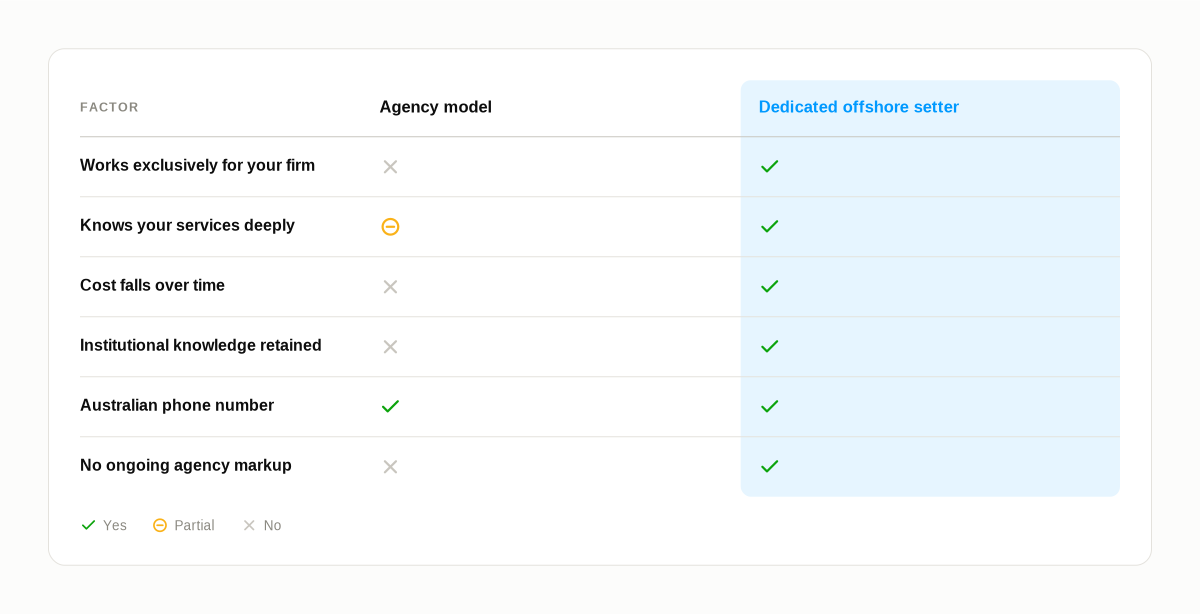
What none of those pricing pages mention is the structural problem underneath. The caller representing your firm is also representing several other clients in the same week, your brand, your services, and your ideal client profile are one set of notes among many. Scripts are adapted from agency templates, so your pitch is built on something generic rather than on how your best clients actually describe the value of working with you. When you cancel, everything stops: the calls, the follow-up sequences, and all the institutional knowledge the caller built about your prospects, your common objections, and what messaging works. You start from zero next time.
What it costs to hire your own offshore appointment setter in the Philippines

Hiring an offshore appointment setter directly involves two costs: the setter’s salary and a one-off placement fee.
Appointment setter salaries in the Philippines, working Australian business hours, run across three tiers:
- Entry level (1–2 years experience): AUD $12,000–$18,000 per year. Can run a provided script, handle basic CRM data entry, and conduct email outreach.
- Mid-level (3–5 years): AUD $18,000–$26,000 per year. Outbound calling experience, can handle objections, book qualified meetings, and track pipeline activity.
- Senior (5+ years): AUD $26,000–$36,000 per year. B2B appointment setting background in professional or financial services, able to refine messaging and train junior setters if your firm grows.
Tarino’s placement fee is a one-off fee of $250 upfront plus $4,750 on hire, excl. GST. There is no ongoing monthly markup on the setter’s wage. The client hires and pays the appointment setter directly. Tarino is not in the middle of that relationship after placement. A 6-month replacement guarantee is included at no extra cost.
For a broader look at how this model differs from traditional outsourcing arrangements, the guide on how to hire offshore staff without paying agency markups covers the structural differences in detail.
Three-year cost comparison
The numbers below use a mid-level offshore appointment setter at $22,000 per year, an agency retainer at $5,000 per month, and a per-booked-appointment rate of $250 for 10 meetings per month. All figures are AUD.
Model | Year 1 | Year 2 | Year 3 | 3-year total |
|---|---|---|---|---|
Agency retainer ($5,000/month) | $60,000 | $60,000 | $60,000 | $180,000 |
Per-booked-appointment (avg $250, 10 meetings/month) | $30,000 | $30,000 | $30,000 | $90,000 |
Dedicated offshore setter (mid-level, $22,000/year) | $27,000 ($22K + $5K fee) | $22,000 | $22,000 | $71,000 |
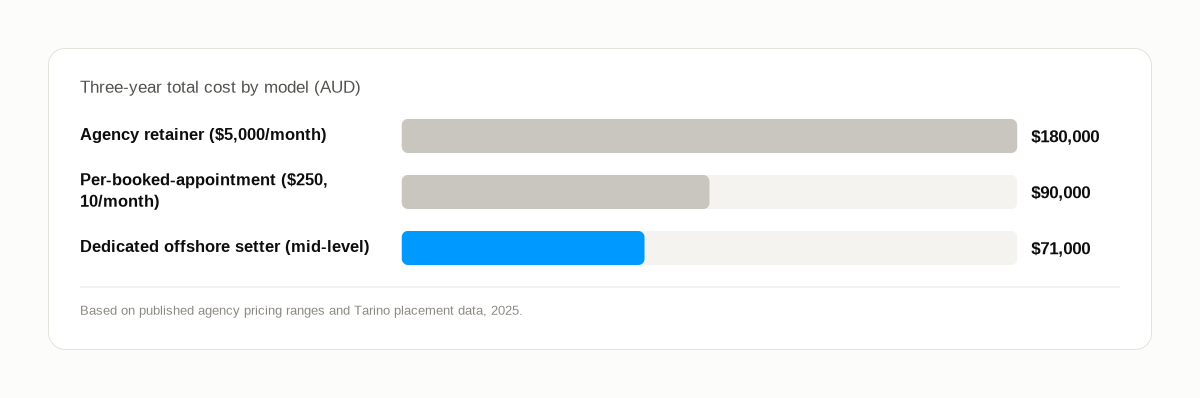
Over three years, a dedicated offshore appointment setter costs $19,000–$109,000 less than agency alternatives, and that gap widens every year because the placement fee is paid once only. The financial comparison also misses something the table can’t show: a setter who has worked with your firm for two years uses market research to define the ideal customer profile before building lists, knows exactly which objections come up, which prospect types show real interest, and qualifies against need, budget, authority, and timing so meetings are booked with genuinely interested prospects. That knowledge doesn’t appear on a spreadsheet, but it shows up in your calendar.
What a dedicated appointment setter does each day for lead generation

A dedicated setter working Australian hours handles the full outreach cycle, not just the calls. For a detailed look at how a sales support hire keeps your pipeline moving, including how outreach activity connects to your broader business development, that post covers the operational picture well. Day to day, the work looks like this:
- Research and build prospect lists using LinkedIn, industry directories, and CRM data
- Send personalised outreach emails using your firm’s brand and templates
- Make outbound calls to warm prospects. LinkedIn connections, existing contacts, event attendees
- Run follow-up sequences: email, call, and LinkedIn message over a 7–14 day cadence
- Handle incoming enquiries from your website or LinkedIn
- Book qualified meetings directly into the principal’s calendar
- Record all outreach and outcomes in your CRM (HubSpot, Salesforce, Pipedrive, or similar)
- Prepare a weekly pipeline report: prospects contacted, follow-ups pending, meetings booked, calls that didn’t qualify
They work AEST or AEDT hours and present an Australian local number via VoIP platforms like JustCall or RingCentral. The person receiving the call sees a local number on their screen, which helps with the Australian market because decision makers often respond better to onshore callers and local familiarity; in many campaigns, Australian decision makers respond 2 to 3 times better to onshore SDRs, and an Australian-based appointment-setting presence can also improve meeting show rates significantly.
Australian phone presence for offshore appointment setters

The most common concern is straightforward: “Won’t people know they’re offshore?” With JustCall or RingCentral, the outbound call presents an Australian local number to the recipient, there’s nothing on the caller ID to indicate otherwise. Philippines-based professionals educated in English and experienced in representing Australian firms typically have clear, professional English. The quality of a cold call comes down to the script, the preparation, and the setter’s familiarity with your services, not their postcode. Many appointment setters in the Philippines have worked specifically for Australian accounting, financial advisory, and consulting firms. They understand the landscape: EOFY planning conversations, SMSF compliance questions, the typical objections an accounting prospect raises before agreeing to a Zoom.
When an outsourced appointment setting service makes sense — and when it doesn’t

An agency model suits a specific set of circumstances. A 12-week campaign around a product launch or geographic expansion, for instance, can be spun up quickly without you needing to onboard anyone. If your firm has no CRM and no capacity to manage a person right now, an agency removes that overhead. And if you genuinely don’t know whether outbound calling will generate meetings in your market, a short agency engagement is a lower-commitment way to test before investing in a hire; this is also where outsourced appointment setting can be useful while you’re still validating a market.
Direct hiring makes more sense for firms with ongoing b2b appointment setting needs, anything 12 months or longer. It also suits firms where the setter needs to understand complex services well enough to have a credible conversation. A financial adviser’s appointment setter can’t just read from a generic script; they need to understand what the firm actually does, who the ideal client is, and why a 20-minute Zoom is worth the prospect’s time, with agreed qualification criteria so qualified meetings meet at least four clear standards such as company fit, role, need, and timing. The longer a dedicated setter works with your firm, the better their calls get. Objection responses sharpen, prospect targeting improves, and the cadence finds its rhythm. None of that compounds inside an agency retainer. When agencies resist defining qualification criteria, they often pad meetings, and strong campaigns usually prioritize meeting quality with a 35 to 50 percent qualification rate rather than volume alone.
How the direct-hire process works
To understand how offshore staffing works for Australian firms more broadly, Tarino’s model is covered in full on that page. For appointment setter hires specifically, the process runs like this:
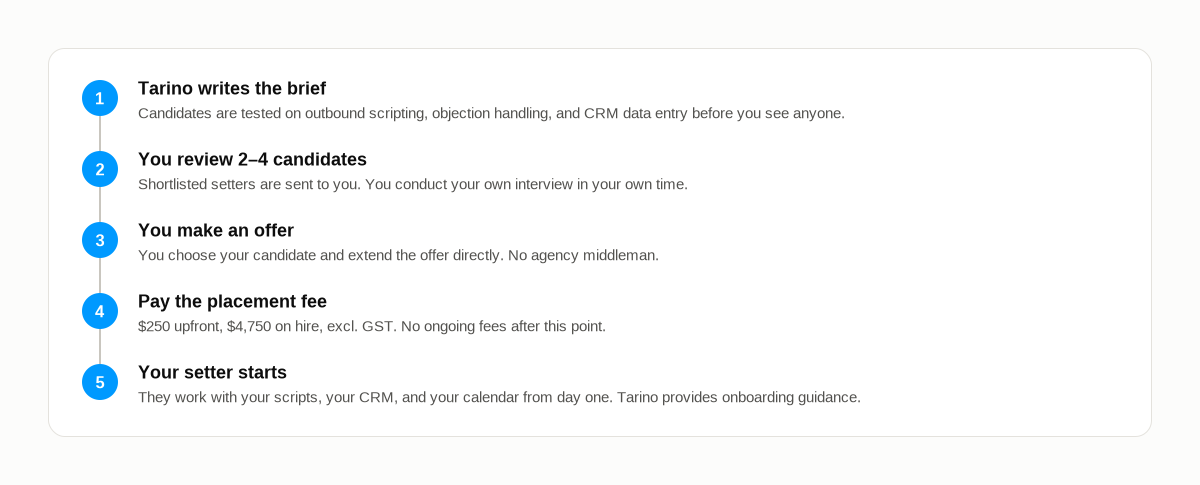
- Tarino writes the brief. Appointment setter candidates are tested on outbound scripting, objection handling, and CRM data entry before you see anyone.
- You review 2–4 shortlisted candidates and conduct your own interview.
- You make an offer to your chosen candidate.
- Pay the placement fee: $250 upfront, $4,750 on hire, excl. GST. No ongoing fees.
- The appointment setter starts with your scripts, your CRM, and your calendar. Tarino provides onboarding guidance.
Average time from brief to hire is 4–6 weeks. For smaller firms where the same person might also handle administrative work alongside outreach, it’s worth considering whether to hire an offshore admin assistant who can cover both functions, a practical option if your outreach volume doesn’t yet justify a full-time setter.
What to look for when you hire appointment setter philippines

Not every appointment setter in the Philippines has experience relevant to Australian professional services. Look for direct outbound calling experience and targeted outreach to a defined target market, rather than inbound support roles, familiarity with the Australian business context (EOFY, BAS, compliance-driven advisory conversations), an understanding of your firm’s business needs and how to brand professionally to new prospects, demonstrated ability to handle objections rather than simply qualify inbound enquiries, and comfort with the specific CRM your firm uses. During the interview, give them a scenario, a real objection you hear frequently, and see how they respond. That tells you more than a resume does.
An appointment setter australia search will return mostly agency results. The direct-hire option requires a different search, but it’s the same role: a person dedicated to booking meetings for your firm, acting as an extension of your sales team to support lead generation and build a stronger sales pipeline, without agency overhead sitting between you and them every month.
The Tarino teamTarino publishes what it learns from the work itself.
This page is general information, not legal, tax or financial advice. Check your situation with a qualified adviser.