



On this page7 sections
- What admin outsourcing actually means in Australia
- What Australian admin outsourcing providers charge for Australian businesses
- What it costs to hire your own Philippines-based admin assistant
- What admin and back office outsourcing works well for — and where it falls short
- What tasks like data entry to look for in a dedicated offshore admin assistant for a professional services firm
- How to decide: outsource the tasks or hire the person to reduce costs?
- How the direct-hire process works through Tarino
Written byTarino Editorial Team**· Offshore Staffing Specialists · Published 21 November 2026
What admin outsourcing actually means in Australia
Australian firms searching for admin outsourcing are usually looking at two fundamentally different things. The first is task-by-task outsourcing: you send work to a provider, they allocate whoever is available from their pool, and you pay for time or deliverables. The second is a dedicated offshore admin assistant your firm hires directly, works exclusively for you, on your systems, during your hours. Most admin outsourcing providers in Australia use the first model, because it suits occasional bursts of work. Firms tend to discover the second model when they realise they’re consistently drawing 20 or more hours a month from a single person who, in practice, barely knows their business.
In this guide
- What admin outsourcing actually means in Australia
- What Australian admin outsourcing providers charge
- What it costs to hire your own Philippines-based admin assistant
- What admin outsourcing works well for — and where it falls short
- What tasks to look for in a dedicated offshore admin assistant for a professional services firm
- How to decide: outsource the tasks or hire the person?
- How the direct-hire process works through Tarino
- Frequently asked questions
What Australian admin outsourcing providers charge for Australian businesses

Admin outsourcing services in Australia are a form of office outsourcing or back office outsourcing for Australian businesses, and are priced three ways: hourly rates, monthly seat fees, and per-task or per-deliverable pricing. Each suits different companies, depending on their requirements and the kind of partner they want. Each pricing model also affects how you compare technology, quality, and proven track record, so research into service scope and performance matters before costs become expensive at scale. For more detail on what specific providers offer, see our guide to outsourced admin services in Australia.
Hourly rates
Most managed admin outsourcing providers in Australia charge somewhere between $35 and $65 per hour, so companies comparing options should assess each partner against their own requirements, including service quality, technology, a proven track record, and visible performance. That range covers firms like AdminHub, Virtual Business Central, and Beepo’s admin offering. The rate looks simple until you scale it. At $35 per hour, full-time-equivalent output of 160 hours per month costs $5,600 per month, or $67,200 per year, before you’ve replaced a single dedicated seat. At $65 per hour, that same 160 hours costs $124,800 annually. Many back office outsourcing companies globally charge less than $25/hr, but Australian-managed pricing is typically higher; in fact, 60% charge below that level. Most firms don’t buy 160 hours a month from a provider, but those that consistently need 50 to 80 hours find the hourly bill running well ahead of what a salaried person would cost, limiting cost savings and making it harder to reduce costs tied to wages, benefits, and office space. For teams that need ongoing support, that is rarely the most efficient setup.
Monthly seat fees
Some providers package their admin outsourcing services as a fixed monthly seat at $3,500 to $6,500 per month, typically covering the staff member’s wages, payroll processing, compliance administration, IT support, and the provider’s management overhead. This kind of office support often costs less because outsourcing partners operate in regions with lower labor costs and reduced overhead such as office space. The predictability is useful. What you’re also paying for, though, is someone else managing that person day to day, taking care of routine responsibilities and billing you a margin for the privilege. At $3,500 per month the annual cost is $42,000; at $6,500 it is $78,000. Neither figure is unreasonable for a managed service, but both become harder to justify against the direct-hire alternative for ongoing operations. In some markets, outsourcing can reduce costs by around 40% versus in-house support, but Australian hourly pricing often narrows that benefit at sustained usage.
Per-task and per-deliverable pricing
Some admin outsourcing providers charge per deliverable rather than per hour. Data entry records might be priced at $5 to $15 each, with accuracy tied to clear standards; a formatted proposal at $50 to $200. For genuinely irregular burst tasks, an annual event, a one-off data migration, an ad hoc project, this model is clean and cost-controlled when workflows are written and agreed in advance. It becomes expensive quickly when volume is high or when tasks require context your provider doesn’t have, especially if expectations around operations and turnaround times are vague. If the work needs someone who knows your clients and your files, a per-deliverable arrangement means repeatedly re-briefing a stranger and paying them to handle day-to-day office support responsibilities plus some operating overhead, rather than just the work completed.
What it costs to hire your own Philippines-based admin assistant

Hiring a dedicated Philippines-based admin assistant directly is a different model entirely. The person is on your payroll, works your hours, uses your systems, and builds knowledge of your practice over time.
Salary for a Philippines-based admin assistant ranges from approximately $18,000 to $28,000 AUD per year, depending on experience and role complexity. That range reflects NCR minimum wage at the lower end through to an experienced admin working in a mid-tier professional services firm at the upper end, giving you access to offshore talent without local hiring delays. On top of salary, Philippine law requires a 13th month pay (one additional month’s salary, mandatory) and employer statutory contributions: SSS at 9.5%, PhilHealth at 5%, and Pag-IBIG at 2%. Those contributions add approximately $3,400 to $4,400 per year at the salary bands above. The Philippines also has 20 public holidays in 2026, with regular public holidays attracting a 100% premium pay entitlement under Philippine law.
Tarino charges one fee of $250 upfront plus $4,750 on hire (excl. GST), with no ongoing monthly markup. You hire and pay the admin assistant directly. Tarino is the recruiter, not an intermediary sitting between you and your staff member every month, which can free your core team for higher-value work and support business growth.
Put the numbers together and the comparison is straightforward:
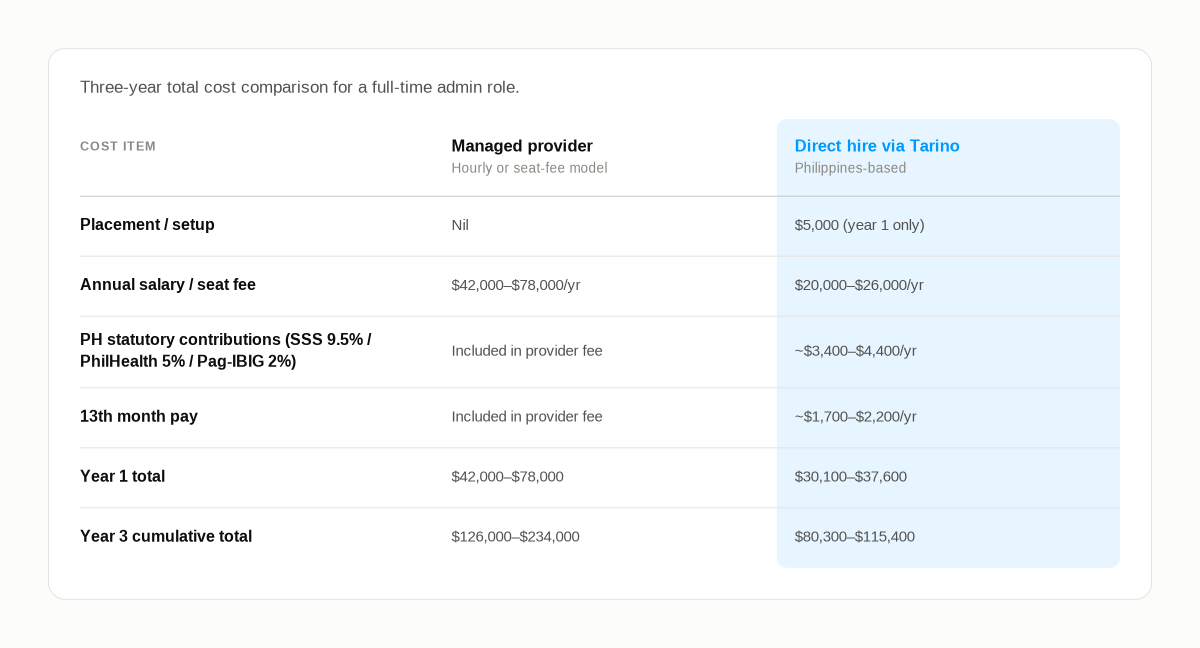
In year 1, the direct-hire model costs $30,100 to $37,600 all-in. A managed outsourcing seat costs $42,000 to $78,000 for the same year. That difference can matter if you need a scalable support model or broader remote workforce solutions as workloads change. By year 3, the cumulative difference is substantial: $80,300 to $115,400 for direct hire versus $126,000 to $234,000 through a managed provider.
What admin and back office outsourcing works well for — and where it falls short

Managed admin outsourcing services are genuinely useful in specific situations. Irregular admin bursts, a large data entry project, event coordination, a one-off document formatting job, are faster to handle through a provider with available capacity than by hiring someone. Direct hire, by contrast, gives firms access to offshore talent through a more scalable model than expanding the local team. Firms with no internal bandwidth to onboard a new staff member also benefit from handing that management to a provider, at least initially.
The model falls short on recurring, contextual work. Admin support that touches client files, matter management, billing, and scheduling requires someone who knows your practice. The more the work depends on institutional knowledge, your clients’ preferences, your partners’ calendars, your practice management software configuration, and day-to-day communication, the less value you get from a provider that allocates whoever is available. Each task handover carries a re-briefing cost that disappears when one person owns the work. That matters for efficiency across core business processes, especially when you are creating the conditions for one person to perform consistently inside your team. Many companies pursue outsourcing primarily for talent access, with 70% of companies identifying it as a key driver.
Confidentiality is also a practical consideration. If your admin tasks involve client files, engagement documents, or financial information, the person handling that material should be someone your firm has hired, background-checked, and given a clear employment agreement, not a rotating pool of workers at a third-party provider. That approach can also improve operational efficiency by reducing admin burden, which frees the core team for client work and business growth.
What tasks like data entry to look for in a dedicated offshore admin assistant for a professional services firm

A well-matched offshore admin assistant can cover a wide range of administration without touching the technical or advisory work your qualified staff do. For repeatable admin work, managed providers can improve operational efficiency when business processes are standardized, helping your team keep its focus on higher-value work. The tasks below are the ones Australian accounting practices, law firms, and consulting firms most commonly assign:
Some outsourced or dedicated offshore teams can improve operational efficiency by up to 30% when workflows are well defined.
- Document preparation and formatting, proposals, client letters, reports, and templated correspondence formatted to your firm’s standards.
- Calendar and email management for partners, scheduling meetings, managing inboxes, drafting routine responses, and keeping principals’ days organised, with every meeting and date kept up to date.
- Matter and file management, CRM data entry, keeping records current in practice management platforms like Karbon, Xero Practice Manager, or MYOB AO.
- Billing, invoice tracking, and accounts follow-up, admin-level billing support, chasing outstanding invoices, and reconciling billing records (not bookkeeping).
- Client onboarding packs and engagement letter dispatch, preparing and sending new client documentation, tracking returns, and updating records when documents are signed.
- Reception support by email, handling enquiries, taking messages, booking meetings, and managing the front-of-house administration your firm does digitally. This kind of office support can also help teams deliver faster responses for customers. Recurring work performs best when one person has context and communication is consistent, which creates the right workflow conditions for a dedicated admin assistant to perform well over time.
How to decide: outsource the tasks or hire the person to reduce costs?
The decision comes down to volume, consistency, and context, and the right step is choosing a well-matched offshore admin assistant who can deliver reliable office support so your qualified staff can stay focused on higher-value work.
Fewer than 30 hours of admin work per month, and task-by-task outsourcing is the right fit. Use this stage to determine which recurring tasks can be handed off and to understand whether the workload is regular enough to justify a dedicated person. The work is too irregular to justify the full-time cost of a dedicated person, and a managed provider gives you flexibility without commitment.
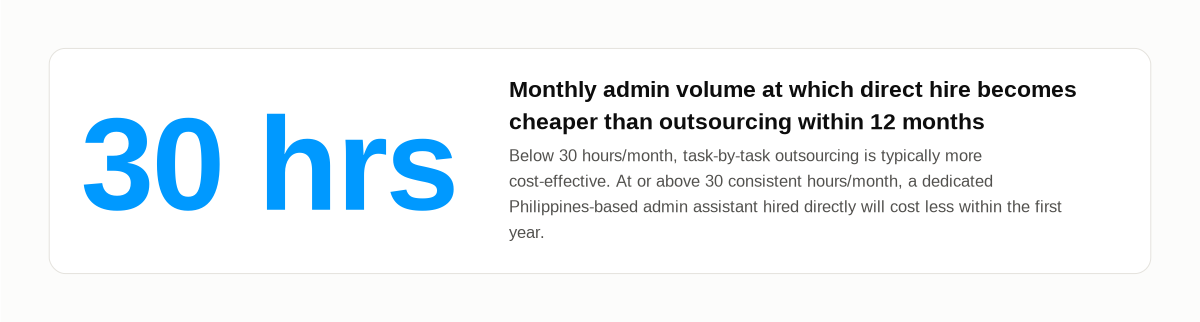
At 30 or more consistent hours per month, a dedicated offshore hire will cost less within 12 months. The figures above make that clear: the managed provider model at any price point above $35 per hour runs ahead of a salaried assistant once hours are consistent. For outsourced admin support at that volume, the seat-fee model and the direct-hire model are broadly comparable in year 1, and direct hire is materially cheaper by year 2. It is also a more scalable option when you need support that can expand with business growth.
If the work is highly contextual, your clients, your files, your systems, your partners’ preferences, a dedicated hire builds institutional knowledge no managed provider can replicate. That knowledge compounds over time and reduces the supervision burden on your internal staff. A provider allocating rotating workers cannot build it at all. If you are ready to delegate calendar and email management, a dedicated assistant keeps calendars up to date. For reception support, faster handling of enquiries can improve customer service quality, and dedicated offshore teams can improve response times for customer inquiries.
How the direct-hire process works through Tarino

Tarino charges one fee of $250 upfront plus $4,750 on hire (excl. GST), with no ongoing monthly markup. The decision starts by determining the volume, consistency, and context of the work, then taking time to understand what support the business actually needs. Tarino writes the job brief, posts it, screens applicants using video interviews and practical tasks, runs structured scorecards, and presents a shortlist of typically three to five candidates. You interview, select, and make the offer. Tarino provides a six-month replacement guarantee.
Many companies now prioritize scalable back office operations when making this choice, with 70% of companies prioritizing scalable back office operations. A good partner should also match your expectations on workflow, communication, and technology, whether the role supports admin, coordination, or design needs.
For more detail on the process, see our full guide on how to hire an offshore admin assistant in Australia, or read the broader overview on how to hire offshore staff without markups. Direct hire is the next step once the business is ready for more scalable support that can keep up with business growth.
The Tarino teamTarino publishes what it learns from the work itself.
This page is general information, not legal, tax or financial advice. Check your situation with a qualified adviser.