



On this page8 sections
- Payroll Officer Salary: Australia vs the Philippines (2026)
- Payroll officer salary guide in Australia (2026)
- Payroll officer job description: What Australian payroll officers actually do
- Payroll officer salary in the Philippines — for Australian-focused roles
- Payroll officer salary by software platform (Australian context)
- The cost comparison: local payroll officer vs offshore direct hire
- Who typically hires an offshore payroll officer in Australia
- Payroll officer vs senior payroll officer vs payroll specialist vs payroll manager — what’s the difference?
Written byTarino Editorial Team**· Offshore Staffing Specialists · Published 18 November 2026
Payroll Officer Salary: Australia vs the Philippines (2026)
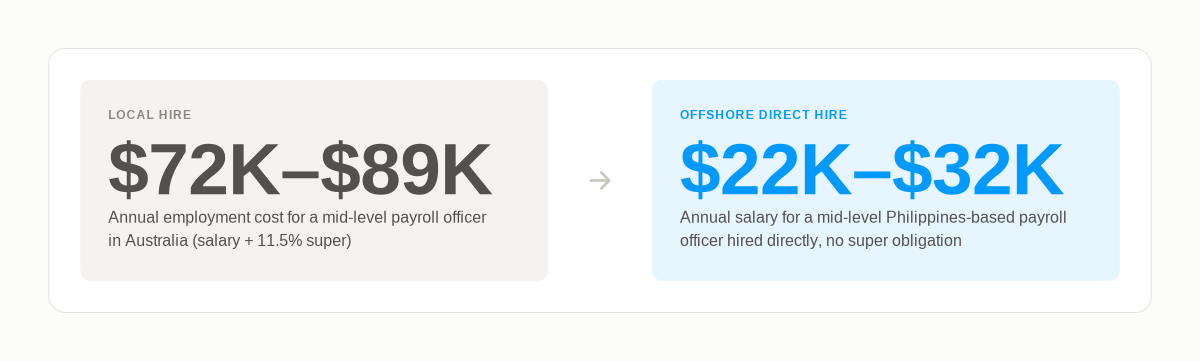
Payroll officer salary in Australia ranges from AUD $55,000 to $95,000 per year for non-management roles, depending on experience, software proficiency, and the complexity of the payroll they manage. Add superannuation at 11.5% and the real employment cost for a mid-level hire sits between $72,000 and $89,000 per year. In the Philippines, payroll officers with genuine Australian payroll experience and working Australian Eastern Standard Time earn AUD $16,000 to $32,000 per year as a direct hire.
In this guide
- Payroll officer salary in Australia (2026)
- What Australian payroll officers actually do
- Payroll officer salary in the Philippines — for Australian-focused roles
- Payroll officer salary by software platform (Australian context)
- The cost comparison: local payroll officer vs offshore direct hire
- Who typically hires an offshore payroll officer in Australia
- Payroll officer vs payroll specialist vs payroll manager — what’s the difference?
- Frequently asked questions
This guide covers Australian payroll officer salary benchmarks by experience level and state, Philippine salary benchmarks for Australian-focused payroll roles, the cost comparison between local and offshore direct hire, and what businesses considering a direct hire actually need to know. If you’re also weighing the broader question of outsourced payroll options in Australia, that page sets out the alternative models.
Payroll officer salary guide in Australia (2026)
The table below shows payroll officer pay across experience levels. These are base salary figures, excluding super.
Experience level | Typical role title | AUD/year salary range |
|---|---|---|
Entry level (1–2 years) | Payroll officer, payroll administrator | $55,000 , $65,000 |
Mid-level (3–5 years) | Senior payroll officer, payroll specialist | $65,000 , $80,000 |
Senior (5+ years) | Senior payroll specialist, payroll team leader | $80,000 , $95,000 |
Payroll manager (team of 3+) | Payroll manager | $90,000 , $130,000 |
State variation: NSW and VIC salaries typically run 5–10% above the national average. Queensland and WA sit roughly at the median; SA and TAS tend to come in slightly lower. For a mid-level hire, the gap between $65,000 in Adelaide and $80,000 in Sydney is explained entirely by location, not skill.
Total employment cost: Superannuation at 11.5% brings the total employment cost for a mid-level payroll officer in Australia to approximately $72,000 to $89,000 per year. That’s what the hire actually costs the business, before office space, equipment, or payroll system licences.
Complexity matters more than industry: A payroll officer managing a 50-person firm under a simple award is paid less than one managing 300 employees across multiple enterprise agreements (EBAs) with STP Phase 2 reporting, rostering software integrations, and leave accruals for part-time and casual staff. When benchmarking, weight complexity heavily. Industry sector is secondary.
Payroll officer job description: What Australian payroll officers actually do

Not every business hiring for this role has a clear picture of the full scope. A capable payroll officer is responsible for a wide range of day-to-day tasks, including all of the following:
- Process weekly, fortnightly, or monthly payroll for all employees, keeping payroll information up to date so staff are paid correctly and on time
- Calculate and apply award rates, penalty rates, overtime, and EBA entitlements
- Manage STP Phase 2 reporting to the ATO (Single Touch Payroll) and support government reporting under government regulations
- Process leave requests, terminations, redundancies, final pay calculations, and set up new employee records while maintaining accurate employee records
- Administer superannuation contributions and clear them to the SuperStream system
- Handle PAYG withholding, payroll taxes, and taxes to ensure compliance with tax file declaration data
- Manage payroll system configuration across platforms including Employment Hero, KeyPay, Micropay, ADP, Preceda, MYOB Payroll, Xero Payroll
- Run payroll reconciliations and report on headcount costs to finance, including putting monthly and quarterly payroll data together for internal reporting
- Handle salary packaging and novated leases if applicable
- Respond to employee pay queries
Australian payroll is structurally complex. The Modern Award system covers 122+ awards, each with different rate tables, penalty structures, and allowances. STP Phase 2 added disaggregated income type reporting that most other countries don’t have. Variable leave types (annual, personal, long service), cashing out provisions, and super obligations across part-time and casual staff compound that further. A payroll officer with the skills, organisational skills, communication, problem-solving, professionalism, attention to detail, and ability to multitask needed for administering payroll across all of these is worth finding, especially when handling confidential information is part of why professionalism and detail matter in payroll work.
Payroll officer salary in the Philippines — for Australian-focused roles

There is a large and growing pool of Philippines-based payroll professionals trained on Australian payroll systems through BPO firms servicing Australian accounting groups, HR platforms, and staffing companies. This pool understands STP Phase 2, Modern Award structures, Employment Hero, Xero Payroll, and Australian leave frameworks. Many are experienced payroll professional candidates with several years of hands-on Australian payroll processing experience, making it a practical career path for people with Australian processing experience. If you’re considering this route, the page on how to hire an offshore payroll officer in Australia covers the practical steps.
Experience level | Description | AUD/year salary (direct hire, working AEST) |
|---|---|---|
Entry level (1–3 years, AU payroll exposure) | Australian payroll processing under supervision | $16,000 , $22,000 |
Mid-level (3–6 years, AU payroll BPO background) | End-to-end payroll processing for 50–300 employees | $22,000 , $32,000 |
Senior (6+ years, multi-entity or EBA complexity) | Senior payroll specialist, can review and manage junior staff | $28,000 , $38,000 |
These are direct-hire salary ranges, what you pay the person. Under a managed BPO model, the equivalent role costs $42,000 to $54,000 per year once the provider’s margin is added on top. Hiring directly also means you own the relationship: the person works for your business, in your systems, to your processes.
Philippines statutory obligations for the employer include SSS contributions (9.5% employer share), PhilHealth (5%, split between employer and employee), and Pag-IBIG (2%). A 13th month payment equal to one month’s basic salary is also required by December 24 each year. These add to the total cost but remain well below Australian super obligations in absolute dollar terms.
Payroll officer salary by software platform (Australian context)
Software proficiency is one of the clearest salary signals in Australian payroll hiring. The platform a business runs shapes what they need, and what they’ll pay for it.
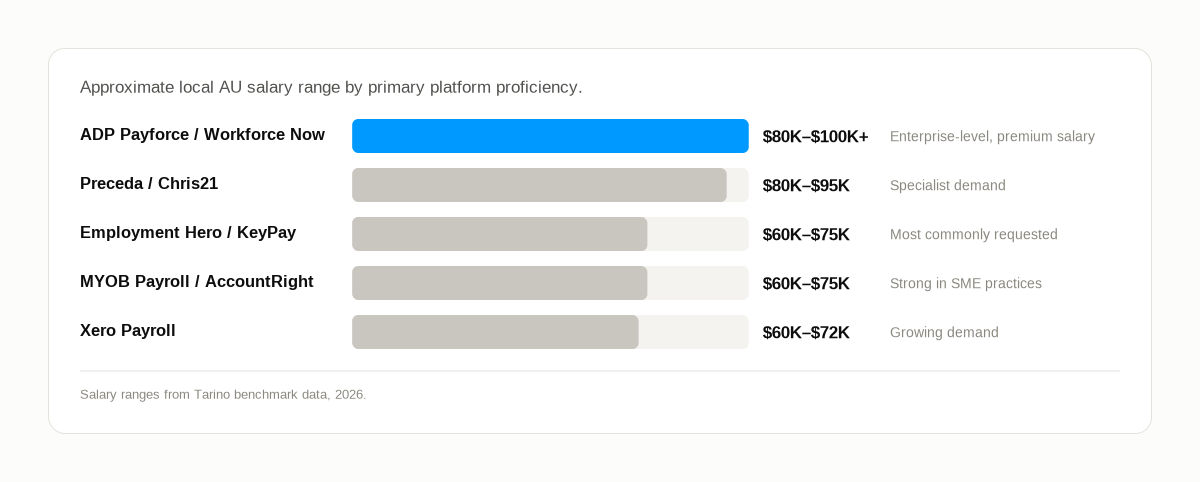
- Employment Hero / KeyPay: The most commonly requested platforms for Australian payroll outsourcing and offshore teams. Certified users command a slight premium. Local salary: AUD $60,000–$75,000. Philippines equivalent: $20,000–$28,000.
- MYOB Payroll / MYOB AccountRight: Strong in SME accounting practices. Salary comparable to Employment Hero locally; still widely requested for accounting firm payroll bureaus.
- Xero Payroll: Growing demand as Xero firms expand their payroll offering. Often combined with a Xero bookkeeping role, which can affect how the position is scoped and priced.
- ADP Payforce / ADP Workforce Now: Enterprise-level payroll. Commands a premium locally ($80,000–$100,000+). Philippines equivalents with ADP experience: $28,000–$38,000.
- Preceda / Chris21: Specialist demand from larger organisations, often in professional services and healthcare. High local premium; not as commonly found in the offshore candidate pool.
The cost comparison: local payroll officer vs offshore direct hire

The table below shows the full cost picture for a mid-level payroll officer. For context on structuring this kind of hire without ongoing agency costs, see the guide on how to hire offshore staff without monthly markups.
Australian payroll officer (mid-level) | Philippines-based payroll officer (mid-level, direct hire) | |
|---|---|---|
Annual salary | $65,000–$80,000 | $22,000–$32,000 |
Super (AU: 11.5%) | $7,475–$9,200 | None, not an AU obligation |
Total employment cost | $72,475–$89,200 | $22,000–$32,000 |
Placement fee | N/A | $5,000 (once only, Tarino fee) |
Year 1 total | $72,475–$89,200 | $27,000–$37,000 |
3-year total | $217,000–$268,000 | $71,000–$101,000 |
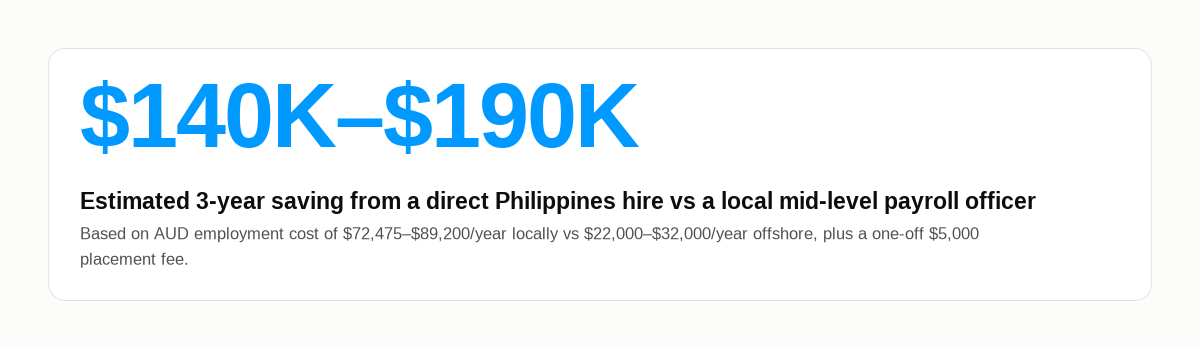
The salary saving over three years is approximately $140,000 to $190,000 for a mid-level payroll officer. The placement fee (AUD $5,000, paid once) is returned within 3–4 weeks of the hire starting. Tarino’s fee structure: “One fee of $250 upfront plus $4,750 on hire, excl. GST, no ongoing monthly markup.” A 6-month replacement guarantee is included at no additional cost.
Who typically hires an offshore payroll officer in Australia

Accounting firms, HR consulting firms, and professional services practices managing payroll across multiple clients are the most common users of Philippines-based payroll officers. A single Philippines-based payroll officer can process payroll for 10–20 client firms using Employment Hero or KeyPay under the supervision of an Australian payroll manager. The model works because the processing work, data entry, payment runs, leave calculations, STP lodgement, is repeatable and system-based. For more on how this applies at firm level, the page on offshore staffing for accounting firms covers the broader context.
Medium-sized businesses with 50 to 300 employees and internal payroll functions are also increasingly hiring Philippines-based payroll officers to handle the processing workload, and company size can affect how much of the payroll function sits with the offshore hire as well as salary expectations for payroll roles. The structure keeps a senior Australian payroll manager or HR manager focused on complex exceptions, EBA interpretation, and staff queries, the judgment-intensive work that benefits from local knowledge and direct access.
Payroll officer vs senior payroll officer vs payroll specialist vs payroll manager — what’s the difference?

A payroll officer processes payroll: data entry, calculations, payment runs. A payroll specialist handles complexity, award interpretation, EBA calculations, termination calculations, reconciliations, and compliance reporting. A payroll manager leads a team, owns the payroll function, and advises business leaders on headcount costs and risk. Australian salaries reflect this directly: officer ($55,000–$70,000), specialist ($70,000–$90,000), manager ($90,000–$130,000). When scoping a hire, be specific about which of these three functions you actually need. The job title alone rarely tells you.
The Tarino teamTarino publishes what it learns from the work itself.
This page is general information, not legal, tax or financial advice. Check your situation with a qualified adviser.