



On this page10 sections
- Contractor or employee: the decision that shapes your Philippines payroll
- SSS, PhilHealth and Pag-IBIG contributions in 2026
- Worked example: an employee on ₱60,000 a month
- What changes if your hire is a contractor
- Should you be outsourcing payroll for Filipino staff?
- Three ways Australian businesses run Philippine payroll
- How to set up payroll for your first Filipino hire
- How to choose the right provider
- What stays on the Australian side
- Where Tarino fits
Payroll outsourcing in the Philippines for an Australian business comes down to one decision: is your hire a contractor or an employee? A genuine contractor invoices you, and you pay the invoice. An employee is owed SSS, PhilHealth and Pag-IBIG contributions, 13th month pay, holiday pay and income tax withheld every pay, and an Australian company with no Philippine entity usually hands that Philippines payroll to an employer of record. This guide sets out the 2026 rates from the official sources, a worked example in pesos, and what each route costs.
We wrote it for Australian business owners who have hired someone in the Philippines, or are about to, and want to pay them correctly. It is general information, not legal or tax advice. If you are still choosing a payment method or a currency, our guide on how to pay overseas staff from Australia covers transfers and records. This page is about what the pay itself must include.
Contractor or employee: the decision that shapes your Philippines payroll
Philippine law decides this by looking at how the work actually happens, not what the contract calls it. In a January 2024 decision about gym trainers signed up as “freelancers”, the Supreme Court of the Philippines applied the four-fold test:
- who selected and engaged the worker;
- who pays the wages;
- who has the power to dismiss; and
- who has the power to control the worker’s conduct, which the Court called the most significant factor.
The Court also said that when status is in dispute, the business carries the burden of proving the person is an independent contractor. If you set the hours, supervise the method and fold the person into your team, you are close to an employment relationship whatever the paperwork says.
Australia has its own version of this problem. Our guide to sham contracting explains the Fair Work rules, and direct hire vs EOR vs contractor compares the three structures side by side.
There is a second, practical issue. The Social Security System defines an employer as a person or business, domestic or foreign, that carries on business in the Philippines, and employer registration runs through the government’s Central Business Portal alongside business registration. An Australian company with no Philippine entity is not set up for that path. That is the main reason most Australian businesses either engage a genuine contractor or use an employer of record, rather than running a Philippine payroll in their own name.
SSS, PhilHealth and Pag-IBIG contributions in 2026
If your hire is an employee, these are the statutory contributions the employer deducts, tops up and remits to three government agencies each month. The rates below are the latest published on each agency’s own site when we checked in November 2026.
| Contribution | Employer share | Employee share | Salary base and cap |
|---|---|---|---|
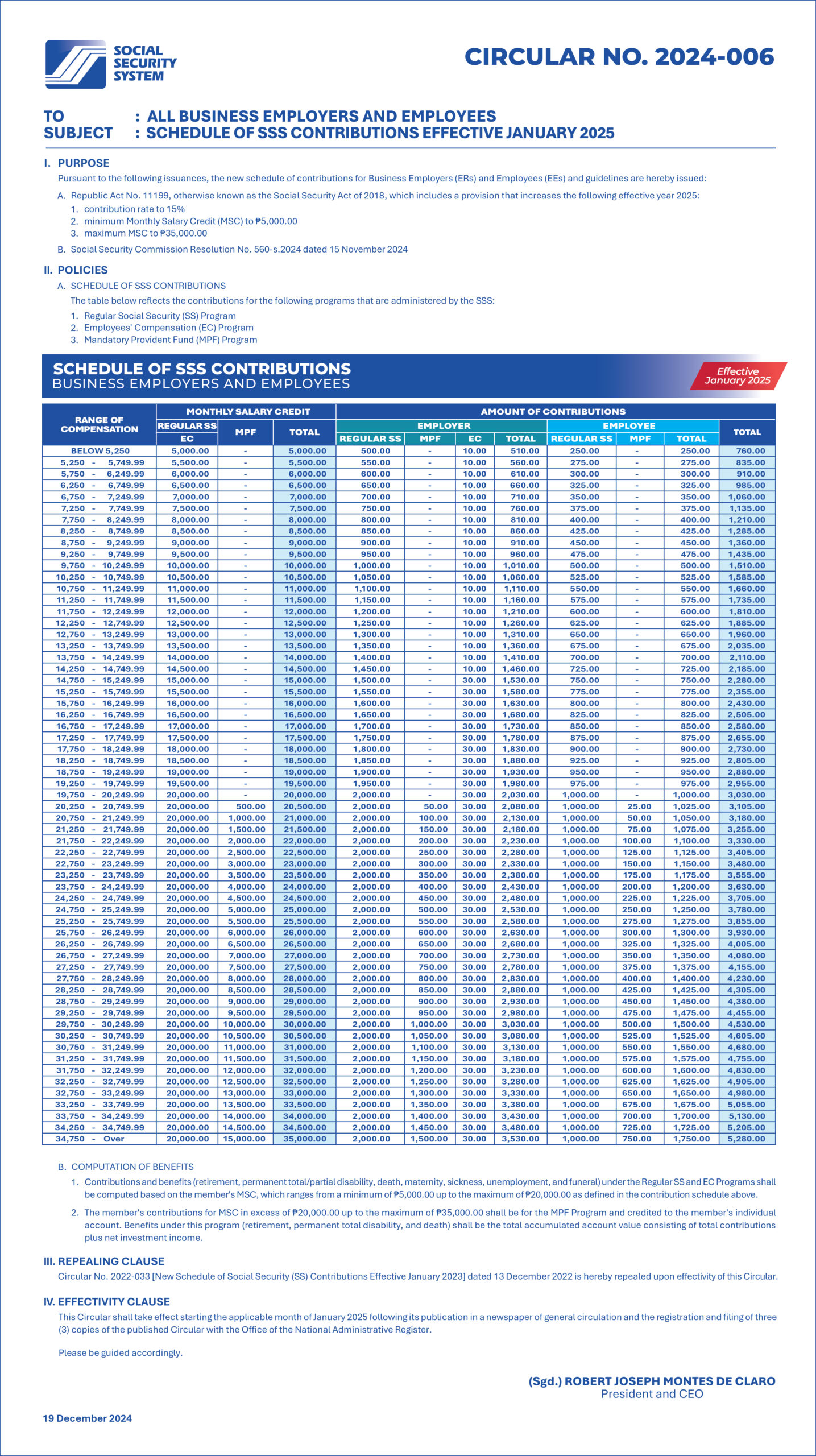
| SSS (incl. MPF and EC) | 10% of the monthly salary credit, plus ₱10 or ₱30 EC | 5% of the monthly salary credit | Credits from ₱5,000 to ₱35,000; maximum ₱3,530 employer and ₱1,750 employee a month |
| PhilHealth | 2.5% of basic salary | 2.5% of basic salary | Salary floor ₱10,000, ceiling ₱100,000; maximum ₱2,500 each a month |
| Pag-IBIG (HDMF) | 2% of fund salary | 2% (1% if salary is ₱1,500 or less) | Fund salary capped at ₱10,000; maximum ₱200 each a month |
SSS contributions
SSS Circular No. 2024-006 set the current schedule of social security contributions from January 2025, as the Social Security Act of 2018 required. The total rate is 15% of the monthly salary credit: 10% from the employer and 5% from the employee. The credit ranges from ₱5,000 to ₱35,000. The first ₱20,000 goes to the regular social security program, and the portion from ₱20,000 to ₱35,000 goes to the Mandatory Provident Fund (MPF), an individual savings account. The employer also pays the Employees’ Compensation (EC) contribution of ₱10 a month, or ₱30 once the credit reaches ₱15,000.
At a salary of ₱34,750 or more, the monthly SSS contribution is ₱5,280: ₱3,530 from the employer and ₱1,750 from the employee. The SSS still listed this as its current table in November 2026. We found no 2026 schedule replacing it.
PhilHealth premiums
PhilHealth’s premium contribution table sets the rate at 5% of monthly basic salary for 2024 to 2025, with a floor of ₱10,000 and a ceiling of ₱100,000. That gives a monthly premium of ₱500 to ₱5,000. PhilHealth Circular No. 2020-0005 says premiums for employees are equally shared by the employee and the employer, so each side pays 2.5%. The table on PhilHealth’s employer page had not been replaced with a 2026 version when we checked, so treat 5% as the latest published rate.
Pag-IBIG (HDMF) contributions
Pag-IBIG Fund Circular No. 460 raised the maximum fund salary from ₱5,000 to ₱10,000 from February 2024. As the Department of Budget and Management’s circular letter on it sets out, the rate is 2% from the employer and 2% from the employee (1% for the employee if their salary is ₱1,500 or less). On any professional salary that means ₱200 from each side, or ₱400 a month. Pag-IBIG’s own site blocks automated checks, so we cite the DBM letter, a Philippine government document.
BIR withholding tax on compensation
Under Section 79 of the National Internal Revenue Code, every employer paying wages must deduct and withhold income tax from them. The rates are the graduated TRAIN law schedule that applies from 1 January 2023, as published by the Bureau of Internal Revenue (BIR):
| Annual taxable income | Tax |
|---|---|
| Up to ₱250,000 | 0% |
| ₱250,000 to ₱400,000 | 20% of the excess over ₱250,000 |
| ₱400,000 to ₱800,000 | ₱30,000 + 25% of the excess over ₱400,000 |
| ₱800,000 to ₱2,000,000 | ₱130,000 + 30% of the excess over ₱800,000 |
| ₱2,000,000 to ₱8,000,000 | ₱490,000 + 32% of the excess over ₱2,000,000 |
| Over ₱8,000,000 | ₱2,410,000 + 35% of the excess over ₱8,000,000 |
The employee’s own SSS, PhilHealth and Pag-IBIG contributions are excluded from taxable income, and 13th month pay and other employee benefits are tax-free up to ₱90,000 a year combined. Tax compliance also means regular filings with the BIR, which is one of the main jobs a payroll provider or employer of record takes on.
13th month pay, holiday pay and night differential
The other items in a Philippine pay run come from the Labor Code and DOLE’s advisories:
- 13th month pay: at least one-twelfth of the basic salary earned in the year, paid by 24 December. Plan for it by accruing one-twelfth of each month’s employee wages. See our 13th month pay guide.
- Regular holidays: paid even when not worked; work on the day is paid at 200% of the daily wage. Special non-working days are “no work, no pay”, and work on them is paid at 130%. Our Philippines public holidays 2026 list shows which dates fall on weekdays.
- Night shift differential: at least 10% extra for each hour worked between 10pm and 6am.
- Overtime: at least 25% extra for work beyond eight hours a day.
- Service incentive leave: five days’ paid leave a year after one year of service, unless the person already gets at least five days of paid vacation leave.
- Pay frequency: at least once every two weeks or twice a month, at intervals of no more than 16 days.
- Minimum wage: set by region. Skilled roles pay well above it, but check the Philippines minimum wage for your hire’s region.
The Philippines runs on UTC+8 all year. A hire working 9am to 5pm Sydney time works 6am to 2pm Manila time in summer (AEDT) and 7am to 3pm in winter (AEST), so Australian business hours rarely attract night differential. Evening support rosters can.
Worked example: an employee on ₱60,000 a month
Here is one month of Philippine payroll for a full-time employee in Metro Manila on a basic salary of ₱60,000, using the rates above. The tax line assumes a full year at the same salary.
| Line | Employer pays | Deducted from employee |
|---|---|---|
| Basic salary | ₱60,000 | |
| SSS (credit ₱35,000) | ₱3,530 | ₱1,750 |
| PhilHealth (5% of ₱60,000, split) | ₱1,500 | ₱1,500 |
| Pag-IBIG | ₱200 | ₱200 |
| 13th month pay, accrued (₱60,000 ÷ 12) | ₱5,000 | |
| Income tax withheld | ₱8,304 | |
| Total | ₱70,230 a month | ₱11,754 a month |
The arithmetic:
- Employer cost: ₱60,000 + ₱3,530 + ₱1,500 + ₱200 + ₱5,000 = ₱70,230 a month, or ₱842,760 a year. The ₱10,230 on top of salary is about 17% at this salary level. Because SSS and Pag-IBIG are capped, that percentage falls as salary rises.
- Tax: taxable pay is ₱60,000 − ₱3,450 in employee contributions = ₱56,550 a month, or ₱678,600 a year. Tax is ₱30,000 + 25% × (₱678,600 − ₱400,000) = ₱99,650 a year, about ₱8,304 a month. The ₱60,000 13th month pay sits under the ₱90,000 exclusion.
- Take-home pay: ₱60,000 − ₱3,450 − ₱8,304 = about ₱48,246 a month, before any holiday or overtime pay.
For a sense of scale, Tarino’s typical salary for an experienced bookkeeper is around $1,400 a month. Use the cost calculator to model your own role, and the Philippines salary guide to set the base pay.
What changes if your hire is a contractor
A genuine independent contractor runs their own business. They invoice you, and you pay the agreed fee. They then look after their own obligations:
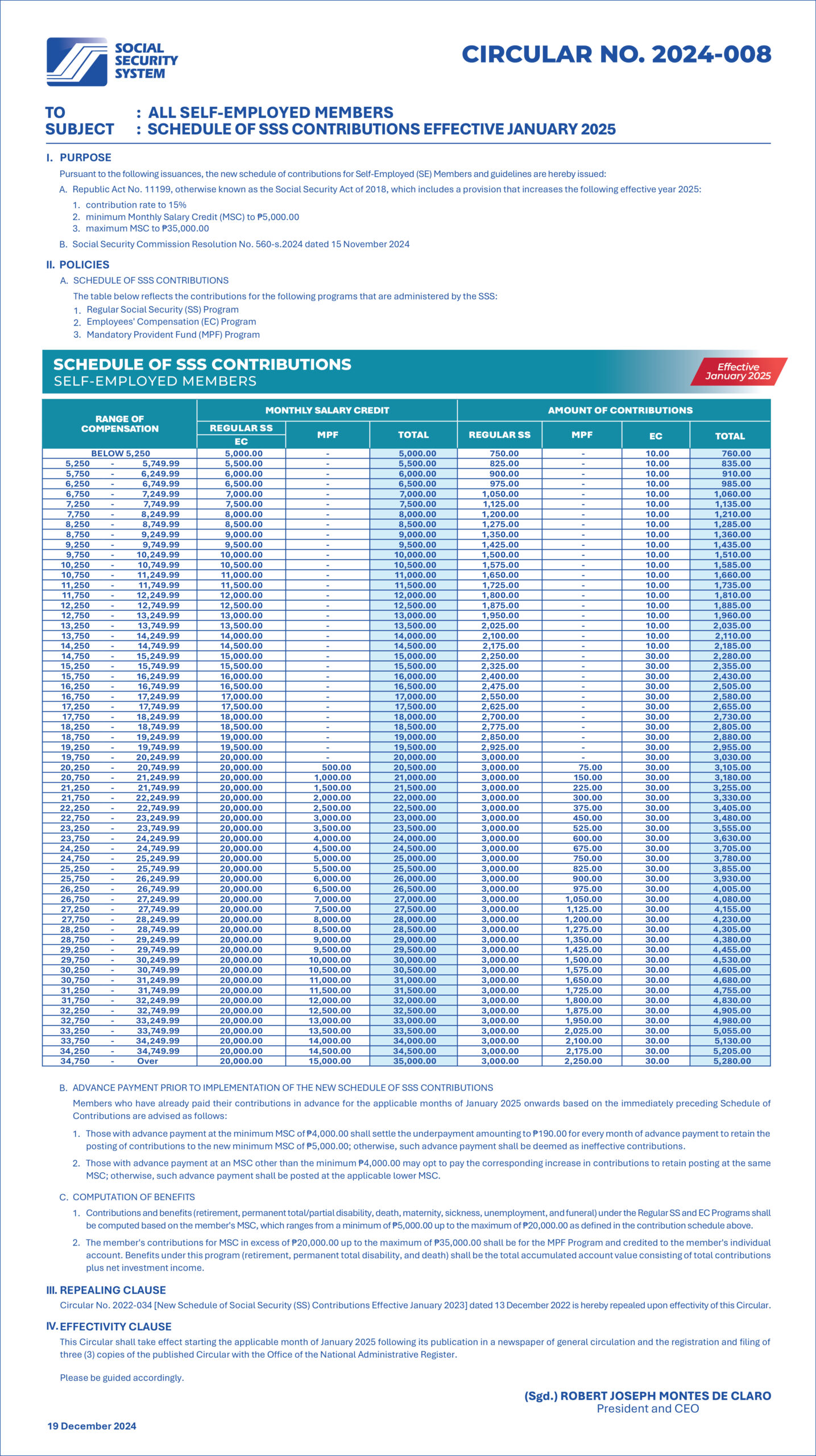
- SSS: a self-employed member pays both the social security and EC contributions themselves, at the same 15% of their declared monthly earnings credit. SSS Circular No. 2024-008 sets the self-employed schedule; at a ₱35,000 credit it is ₱5,280 a month.
- PhilHealth: self-earning individuals sit in the informal economy program, where PhilHealth treats them as both employer and employee, so they pay the full premium.
- Pag-IBIG: self-employed people can contribute as members on their own account.
- Tax: the contractor registers with the BIR. If their gross receipts are no more than ₱3,000,000, they can choose an 8% tax on gross receipts above ₱250,000 instead of the graduated rates and percentage tax.
You do not deduct anything, remit to any government agency or pay 13th month pay. Your costs are the fee, the transfer cost and your own records. Ask whether the rate a contractor quotes is meant to cover their own contributions, so you compare like with like.
The risk sits in the relationship. If the person works fixed hours under your direction, only for you, with no business of their own, a “contractor” agreement may not hold up in the Philippines or in Australia. Get advice before you sign.
Should you be outsourcing payroll for Filipino staff?
Outsourcing payroll in the Philippines means paying a specialist to run the calculations, payslips and remittances instead of managing payroll yourself. For small businesses and medium enterprises in Australia with one to a handful of Filipino staff, the case for it usually rests on four things:
- Compliance. Philippine payroll touches three contribution tables, the BIR tax codes, 13th month pay, holiday rules and regional minimum wages, and each can change during the year. A specialist tracks them and the filing deadlines so you don’t have to stay informed of every advisory yourself. Non-compliance has real costs: the SSS lists penalties for employers that fail to report or remit.
- Time. Working through another country’s payroll rules each month takes time away from your own business operations. Outsourcing saves time if you have no HR team or human resources function in the Philippines.
- Technology. Payroll services run on payroll software that calculates overtime, holiday pay, night differential and deductions automatically, which helps ensure accurate pay. Many offer real-time reporting and payslip portals, so you and your hire can see the same numbers.
- Operational costs. You avoid buying local payroll software or hiring someone in the Philippines just to run a pay cycle for one person.
The downsides are just as real. You pay a fee every month, you still carry the legal responsibility if you are the employer, and you hand sensitive information to another business. You also rely on the provider getting it right: payroll issues such as late or wrong pay are one of the fastest ways to lose a good hire’s trust, so employee satisfaction depends on the provider you choose.
For a single contractor, outsourcing payroll is rarely needed. For an employee, it is close to essential unless you have a Philippine entity and local expertise in-house.
Three ways Australian businesses run Philippine payroll
| Route | Who is the employer | What you handle | Typical cost on top of pay |
|---|---|---|---|
| Pay a contractor directly | No one; the worker is self-employed | A contract, monthly invoices, international transfers, records | Transfer fees only |
| Local payroll service provider | You, through a registered Philippine entity | The entity, registrations and employer duties; the provider runs payroll processing and remittances | The provider’s quote, plus entity setup and accounting |
| Employer of record (EOR) | The EOR, in the Philippines | Directing the work and paying one monthly invoice | A monthly fee per employee, e.g. Tarino EOR at $387 |
Paying a contractor directly is the simplest Philippine payroll. It suits work that is genuinely project-based or independent. You still need a clear contract, a set payday and good records.
A local payroll service provider suits businesses that already have, or are setting up, a Philippine company. The provider uses payroll software to calculate pay, deductions and taxes, prepares payslips and government reporting, and remits contributions on time. You remain the employer, so the legal duty to pay and remit correctly stays with you even when the work is outsourced. Ask each provider for a written quote and compare what it includes before you sign.
An employer of record is the common answer for an Australian business that wants a proper employee in the Philippines without a local entity. The EOR holds the employment contract, runs payroll, withholds tax, pays SSS, PhilHealth and Pag-IBIG, and manages leave, while you direct the day-to-day work. Tarino EOR, powered by Deel, costs $387 per employee per month ($4,644 a year). The salary, employer contributions and 13th month pay are still costs of the job, so ask any provider what is billed with the salary and what is included in the fee.
How to set up payroll for your first Filipino hire
Whichever route you choose, the set-up follows the same order:
- Settle the relationship. Contractor or employee, based on how the work will really run. Get advice if you are unsure.
- Agree the pay in writing. Salary or fee, currency, payday and payment method, plus how holidays, overtime and 13th month pay are handled for an employee.
- Choose who runs payroll. You (contractor payments), a payroll service provider (your own Philippine entity) or an employer of record.
- Register and collect details. For an employee, the provider or EOR registers them and collects their SSS, PhilHealth, Pag-IBIG and tax identification numbers. A contractor gives you an invoice template and bank details.
- Run a test payment. Send a small first transfer, or check the first payslip line by line against the rates on this page.
- Keep records. Payslips or invoices, remittance receipts and proof of each payment, on both sides.
Your finance team, or your bookkeeper, should set up the expense or wage account in your accounting software at the same time so each pay run reconciles cleanly.
How to choose the right provider
Whichever payroll solutions you compare, look for a reliable provider with a track record of serving international clients, and ask the same questions:
- Compliance and expertise: Which filings and remittances do you handle, and who pays the penalty if one is late? Can you show local expertise in Philippine tax and labour law?
- Data protection: Payroll records hold social security numbers and tax returns, which the Data Privacy Act of 2012 classes as sensitive personal information, and the Act sets rules for anyone processing it. Ask about security protocols and who can see the data. Our data privacy checklist covers the Australian side.
- Hidden costs: Setup fees, year-end fees, final pay calculations and currency conversion margins can all sit outside the headline price.
- Reporting: Can you see payslips, remittance receipts and leave balances whenever you need them? Can the data export to your accounting software?
- Service quality: Who answers when a payslip is wrong, and how fast? Can the service flex if your team grows or your specific needs change?
If your business is in Australia, compare this with your own payroll set-up. Our guide to outsourced payroll in Australia covers bureaus, payroll software and in-house payroll officers for your local team.
What stays on the Australian side
Paying someone in the Philippines does not usually bring Australian payroll obligations with it. The ATO says you don’t have to pay super for non-resident employees who work outside Australia, and PAYG withholding is unlikely to be required for most payments to them. Keep the contract, every invoice or payslip, proof of payment and the exchange rate you used, for 5 years. Our guides on super for offshore staff and paying overseas staff go through each point.
Where Tarino fits
Tarino recruits Philippines-based staff for Australian businesses. You hire and pay the person directly, as a contractor or through an EOR. Our fee is $5,000 excl. GST per placement: $250 upfront to start the search, plus $4,750 on hire, with no monthly fees and no markup on salary. If you want the payroll handled, Tarino EOR is optional and separate from the recruitment fee. See pricing, how it works and direct hire vs EOR vs contractor.
If you are still deciding how to source someone, our pages on OnlineJobs.ph alternatives and Upwork alternatives compare the options.
This page is general information, current at 21 November 2026. It is not legal or tax advice. Rates change, so check the SSS, PhilHealth, Pag-IBIG and BIR sites before each year’s first pay run, and speak to a Philippine employment lawyer, accountant or payroll provider about your arrangement.
Sources
- SSS Contribution Table, effective January 2025 (Social Security System)
- SSS Circular No. 2024-006: Schedule of SSS contributions for business employers and employees (Social Security System)
- SSS Circular No. 2024-008: Schedule of SSS contributions for self-employed members (Social Security System)
- Employers: definition, registration and duties (Social Security System)
- Self-employed members (Social Security System)
- Premium contribution table (PhilHealth)
- PhilHealth Circular No. 2020-0005: premium contributions of direct contributors (PhilHealth)
- Informal economy members (PhilHealth)
- DBM Circular Letter No. 2024-2: Pag-IBIG Fund Circular No. 460, contribution rates from February 2024 (Department of Budget and Management)
- Income tax rates (Bureau of Internal Revenue)
- Republic Act No. 10963 (TRAIN Law), tax schedule from 1 January 2023 and 13th month exclusion (Lawphil)
- National Internal Revenue Code of 1997, Section 79 (withholding on wages) and Section 32(B)(7)(f) (Lawphil)
- Labor Code of the Philippines, Articles 83, 86, 87, 94, 95 and 103 (Lawphil)
- PMAP Circular 2026-053: DOLE Labor Advisory No. 13, s. 2026, holiday pay rules
- SC declares fitness trainers of a gym chain as regular employees, 24 January 2024 (Supreme Court of the Philippines)
- Republic Act No. 10173, Data Privacy Act of 2012 (Lawphil)
- Republic Act No. 11199, Social Security Act of 2018 (Lawphil)
- Work out if you have to pay super (Australian Taxation Office)
- Withholding from a foreign resident employee (Australian Taxation Office)
- Overview of record-keeping rules for business (Australian Taxation Office)
- Republic Act No. 10535, Philippine Standard Time Act of 2013 (Lawphil)
This page is general information, not legal, tax or financial advice. Check your situation with a qualified adviser.