



On this page7 sections
Written by Tarino Editorial Team · Offshore Staffing Specialists · Published 20 November 2026
What this guide covers
Looking at staff domain alternatives? You’re likely in one of two spots: you’ve got a quote and the monthly cost is higher than you expected, or you’ve been using them and worked out what you’ve actually spent over 12–24 months. This page compares Staff Domain’s pricing model with other providers and with the direct-hire approach most comparison sites ignore entirely: hiring offshore staff directly, paying a one-off recruitment fee.
In this guide
- What this guide covers
- What Staff Domain offers
- How Staff Domain’s cost model works
- What Staff Domain alternatives look like
- The direct-hire model — the alternative most comparison pages skip
- 3-year cost comparison
- What to ask any offshore staffing provider before signing
- Frequently asked questions
For Australian accounting practices and professional services firms, the choice between staff domain alternatives usually comes down to cost structure rather than capability. The main managed providers all operate from the Philippines and deliver similar quality. The difference is what you pay on top of salary, and for how long.
What Staff Domain offers

Staff Domain is an Australian-owned offshore staffing provider with operations in the Philippines. They handle the HR, payroll, compliance, and facilities on the Philippine side while you get a dedicated staff member working for you directly.
That means you don’t need to know Philippine employment law, deal with local benefits, or manage an office in Manila. For a firm hiring offshore for the first time, that simplicity matters. Staff Domain works with accounting practices, professional services firms, and other industries. They’re an established, legitimate operator.
On staff domain pricing: they don’t publish full rates publicly. What you can infer from the category is that managed offshore staffing fees bundle several components together, which the next section breaks down.
How Staff Domain’s cost model works

Managed offshore staffing fees typically contain three parts, regardless of provider. Understanding these is essential to comparing alternatives to staff domain fairly.
- The staff member’s underlying salary, what they’re actually paid in the Philippines.
- A service margin or markup, typically 20–50% above salary, charged by the provider for HR management, compliance, and infrastructure.
- A facilities or seat fee, the desk, IT setup, utilities, and office space in the Philippine office.
A Philippines-based accountant’s base salary typically ranges from AUD $22,000–$35,000 per year. Add the service margin and seat fee, and the all-in managed staffing cost lands around AUD $45,000–$70,000 annually. Over three years, that’s AUD $135,000–$210,000 for one role.
An admin assistant costs less at base salary, but the markup structure remains the same. The all-in cost is proportionally lower, though the service margin still applies.
These are category-level benchmarks derived from publicly available managed offshore staffing ranges and industry cost patterns; they do not represent Staff Domain’s specific published rates, which are not publicly disclosed. Contact Staff Domain directly for a quote on your specific role and seniority level. The direct-hire salary figures used in the cost comparison table below reflect the same Philippine salary ranges and are drawn from the same benchmark set.
For more detail on how markups work across the industry, see how offshore agency markups are structured.
What Staff Domain alternatives look like

Four main options come up in comparisons. Three are managed providers; one operates on a different model entirely. Evaluating staff domain alternatives means understanding both the operational model and the cost structure behind each option before requesting a quote.
TOA Global
TOA Global is a managed offshore staffing provider focused specifically on accounting firms. Philippines-based, with strong emphasis on accounting software training and onboarding. The pricing structure mirrors Staff Domain: monthly fee covering salary plus service margin. For the full breakdown, see how TOA Global compares to direct hire.
Hammerjack
Hammerjack serves accounting practices and professional services firms from the Philippines. Managed model, ongoing monthly fee, similar cost structure to other providers. If you’re looking at them specifically, the Hammerjack alternatives for Australian professional services firms guide has the detail.
Probe Group and MicroSourcing
These are larger BPO operators with volume-based pricing. They work better for 10 or more seats. For a single hire or a team of two or three, their account management overhead and minimum requirements make them less practical than specialist providers.
Tarino (direct-hire model)
Tarino operates differently. Rather than managing the employment relationship, Tarino recruits and screens, then you hire the person directly. No monthly markup. The recruitment fee is $250 upfront plus $4,750 on hire (excl. GST), a single fee, then you pay the salary directly.
The direct-hire model — the alternative most comparison pages skip

Managed offshore staffing providers pitch their monthly fee as worth paying because it removes administrative burden. That argument holds water for some firms. But it’s worth seeing exactly what that burden is, most Australian professional services principals find it more manageable than the pitch suggests.
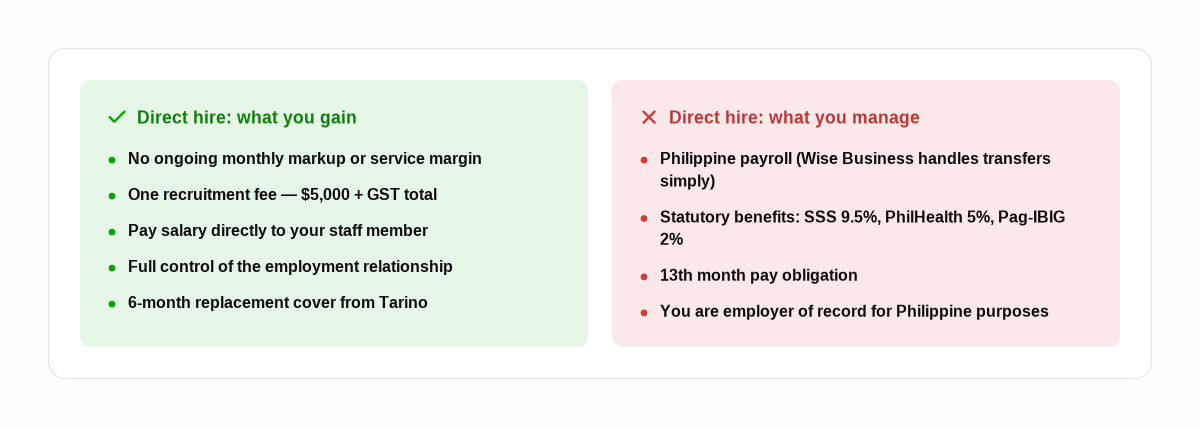
With Staff Domain or similar providers, you pay a monthly fee including salary plus markup, every month indefinitely. With Tarino, you pay one recruitment fee ($5,000 + GST), then pay salary directly to your staff member. No markup, no seat fee, no service margin layered on year after year.
What you handle with direct hire that a managed provider does for you:
- The employment relationship itself, most firm owners find this straightforward once they understand the basics.
- Payroll to the Philippines. Wise Business is the standard tool, functioning like a regular international bank transfer.
- Statutory benefits under Philippine law: SSS contributions at 9.5%, PhilHealth at 5%, Pag-IBIG at 2%, and 13th month pay.
- Employer of record status for Philippine purposes.
This model suits firms that have already used managed offshore staffing and understand how it works, or firms hiring one to three people without paying per-seat overhead on every role indefinitely. It may not suit firms wanting all HR and facilities management handled externally, or firms scaling to 10 or more seats where managed infrastructure becomes genuinely cost-effective.
Tarino also provides 6-month replacement cover. If the hire doesn’t work out in the first six months, you’re not starting the recruitment fee from scratch.
3-year cost comparison

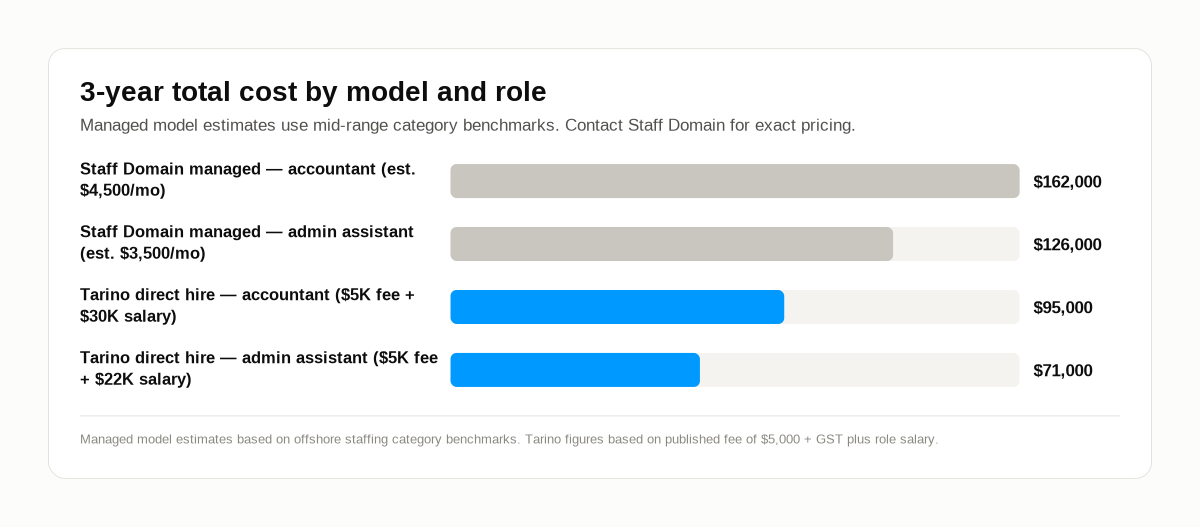
The table below uses mid-range category estimates for Staff Domain’s managed model and Tarino’s published fee structure. The managed model estimates of $4,500/month for an accountant and $3,500/month for an admin assistant are drawn from the same industry benchmark ranges cited above — both figures sit within the AUD $45,000–$70,000 annual all-in range typical for managed offshore staffing at these seniority levels. The direct-hire salary figures reflect the lower end of the same Philippine base salary ranges. Staff Domain’s exact pricing varies by role, seniority, and package; contact them directly for a quote. The figures are a planning tool, not a contract.
| Option | Year 1 | Year 2 | Year 3 | 3-year total |
|---|---|---|---|---|
| Staff Domain managed, accountant (est. $4,500/mo) | $54,000 | $54,000 | $54,000 | $162,000 |
| Staff Domain managed, admin assistant (est. $3,500/mo) | $42,000 | $42,000 | $42,000 | $126,000 |
| Tarino direct hire, accountant ($5K fee + $30K salary) | $35,000 | $30,000 | $30,000 | $95,000 |
| Tarino direct hire, admin assistant ($5K fee + $22K salary) | $27,000 | $22,000 | $22,000 | $71,000 |
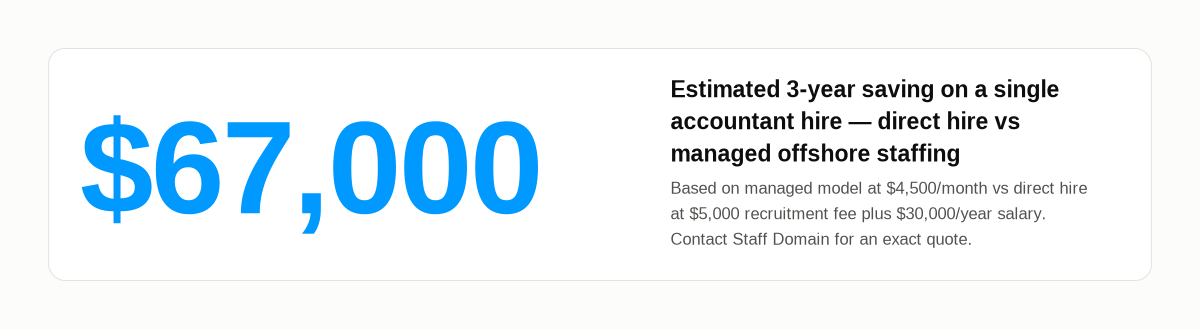
The 3-year gap on a single accountant hire is roughly $67,000. On two or three hires, the difference becomes material. If you’re building a small offshore team across your practice, that gap compounds quickly. Tarino’s 6-month replacement cover means the Year 1 direct-hire figure carries less risk than it appears.
For what a comparable Australian-based hire costs, the accountant cost Australia guide breaks down local salary benchmarks and full employment costs.
What to ask any offshore staffing provider before signing

Whether you’re evaluating Staff Domain, one of the alternatives, or the direct-hire model, these five questions will surface the variables that matter most. Applying them consistently across every staff domain alternative you review makes it easier to compare quotes on a like-for-like basis.
- What is the breakdown of the monthly fee? Ask specifically: what goes to salary, service margin, and facilities. Some providers are transparent; others bundle everything into one figure.
- Is the monthly fee fixed, or indexed to something? Some managed providers apply annual increases tied to Philippine wage growth or CPI. A fee that looks manageable in Year 1 can shift significantly by Year 3.
- What is the exit notice period? Managed providers typically require 30–90 days notice. That notice period determines how long you keep paying if you decide to change models or providers.
- Who is the employer of record? In managed staffing, the provider is. In direct hire, you are (or the person is engaged as a contractor). This determines your legal obligations and control over the relationship.
- What happens if the staff member doesn’t work out? Replacement terms vary significantly. Tarino provides 6-month replacement cover. Ask managed providers what their equivalent guarantee includes.
For a broader view of the Australian offshore staffing market, see how Australia’s main outsourcing providers compare.
The Tarino team
Tarino publishes what it learns from the work itself.
This page is general information, not legal, tax or financial advice. Check your situation with a qualified adviser.