



On this page7 sections
- Outsourcing Philippines: What Australian Businesses Pay Per Role and How to Set It Up
- What “outsourcing Philippines” means for Australian businesses
- The three models for Philippines outsourcing
- What Philippine outsourcing costs by role (AUD per year)
- Which roles outsource well for Australian professional services
- Philippines outsourcing compliance basics for Australian businesses
- How to get started with Philippines outsourcing
Written byTarino Editorial Team**· Offshore Staffing Specialists · Published 13 November 2026
Outsourcing Philippines: What Australian Businesses Pay Per Role and How to Set It Up
Outsourcing to the Philippines means hiring Philippines-based workers — through a managed provider, an Employer of Record, or directly — to perform roles that would otherwise be filled locally, typically saving Australian businesses 70–80% on salaries compared to equivalent local hires. The Philippines is one of the leading BPO destinations globally and the third-largest English-speaking country in the world, making it the most common offshore staffing choice for Australian professional services firms in accounting, legal, financial advisory, and consulting.
In this guide
- What “outsourcing Philippines” means for Australian businesses
- The three models for Philippines outsourcing
- What Philippine outsourcing costs by role (AUD per year)
- Which roles outsource well for Australian professional services
- Philippines outsourcing compliance basics for Australian businesses
- How to get started with Philippines outsourcing
- Frequently asked questions
This guide covers everything you need to understand the landscape before you start: the three models available, what each one costs, which roles outsource well, what Philippine statutory obligations apply to Australian employers, and how the hiring process works from first brief to onboarded staff member.
What “outsourcing Philippines” means for Australian businesses
The Philippines is a leading BPO destination globally, with a large pool of university-educated graduates available for business process outsourcing roles. English is an official language used in Philippine education and in official documents and business communication, which is why Filipinos typically speak English at a level comfortable for Western businesses. Filipino business culture aligns closely with Western practices, reducing the friction that companies often encounter when offshoring to other destinations.
For most Australian businesses, “outsourcing Philippines” describes one of two arrangements: (a) engaging a managed service provider that supplies Philippines-based staff to work on your account — you receive output, not a direct employee — or (b) hiring your own Philippines-based staff member who works exclusively for you, in your systems, on your hours. The word “outsourcing” covers both, which is why costs and structures vary so widely between providers and conversations.
“Australian offshore companies” and offshoring to the Philippines from Australia are terms that most commonly describe option (a): a provider with a Philippine operation that supplies managed services or seats. An “australian agency in the philippines” typically refers to the same category — an Australian-owned or Australian-focused business operating a Philippine delivery centre. Direct hire refers to option (b), where the Philippine staff member is on your payroll and works for no one else. The distinction matters because it determines who controls the work, what you pay, and what rights the worker has.
The three models for Philippines outsourcing

Model 1: Managed BPO (Business Process Outsourcing) / Shared seat
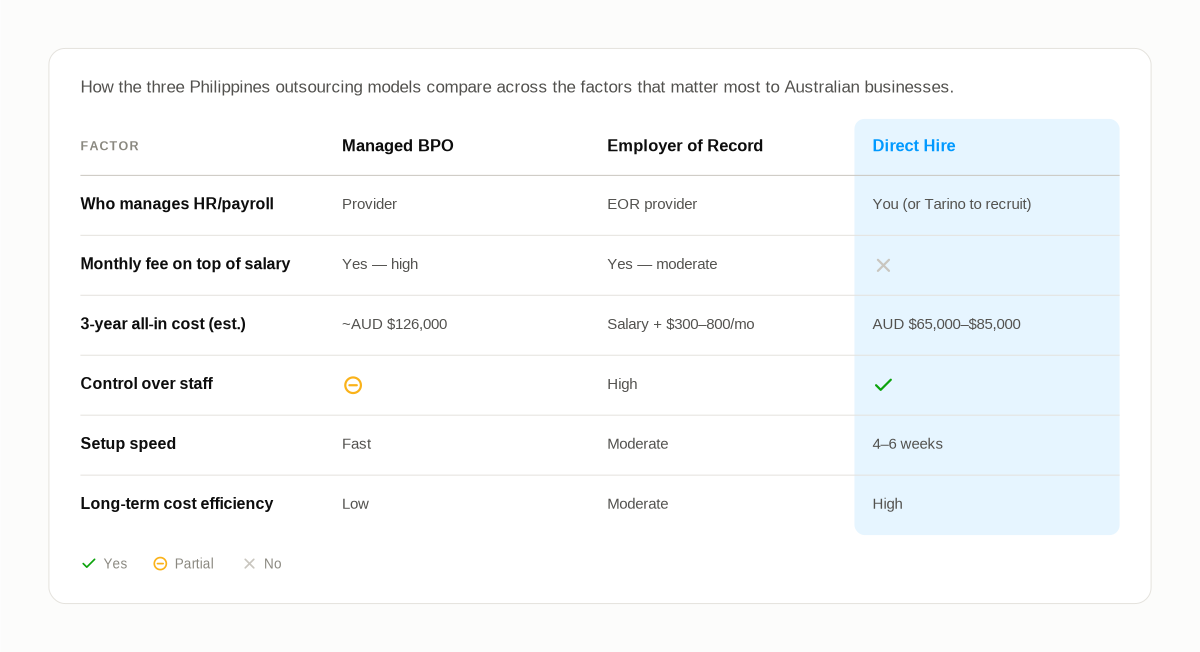
You engage a provider — commonly names like TOA Global, Staff Domain, Beepo, Probe Group, or MicroSourcing — who supplies a Philippines-based staff member to work on your account. The business process outsourcing industry in the Philippines encompasses customer service, bookkeeping, digital marketing, accounting, legal support, and many other service types. You pay a monthly seat fee that typically falls between AUD $2,500 and $5,000 per person per month. That fee covers the staff member’s salary, the provider’s margin, and their facilities, HR, and payroll services. The staff member works from the provider’s office. You have visibility of their output but limited control over their conditions of hire. For detail on what outsourcing companies in Australia and what they charge, see our dedicated breakdown.
Who this suits: Businesses that want someone operational quickly with minimal HR responsibility on their side.
The trade-off: You pay the provider’s margin indefinitely. At $3,500/month over three years, that is $126,000 for one person. The same person hired directly would cost approximately $65,000–$85,000 all-in over the same period — including salary, statutory contributions, and a one-time recruitment fee.
Model 2: Employer of Record (EOR)
An Employer of Record is a third party that legally hires the Philippines-based worker on your behalf, handling payroll, statutory contributions (SSS, PhilHealth, Pag-IBIG), and DOLE compliance. You direct the work day-to-day. EOR fees range from AUD $300–$800 per month on top of the worker’s salary. This model suits businesses that want direct control over their staff but prefer to outsource Philippine HR and payroll administration to a licensed local entity, without establishing their own Philippine legal structure.
Who this suits: Businesses comfortable managing staff directly but not yet ready to run Philippine payroll themselves.
The trade-off: There is still an ongoing monthly fee, though it is substantially lower than a full managed BPO seat. At $550/month (midpoint), that is $19,800 in EOR fees over three years, on top of the salary you are already paying.
Model 3: Direct hire
You hire the Philippines-based person directly as your staff member. They work for you and no one else, in your systems, on your hours, using your processes. You pay their salary directly via Wise Business, Payoneer, or direct Philippine bank transfer, and you manage their statutory obligations under Philippine law. A recruitment firm like Tarino finds and screens candidates for you, then steps out of the relationship entirely once the hire is made.
Tarino charges one fee: $250 upfront plus $4,750 on hire, excl. GST — no ongoing monthly markup. The client hires and pays the staff member directly. Tarino also offers a 6-month replacement guarantee at no additional cost. For a full explanation of how to hire offshore staff without paying monthly markups, see that guide.
Who this suits: Businesses that want maximum control, long-term relationships, and cost efficiency. It is the cheapest model at scale.
What Philippine outsourcing costs by role (AUD per year)

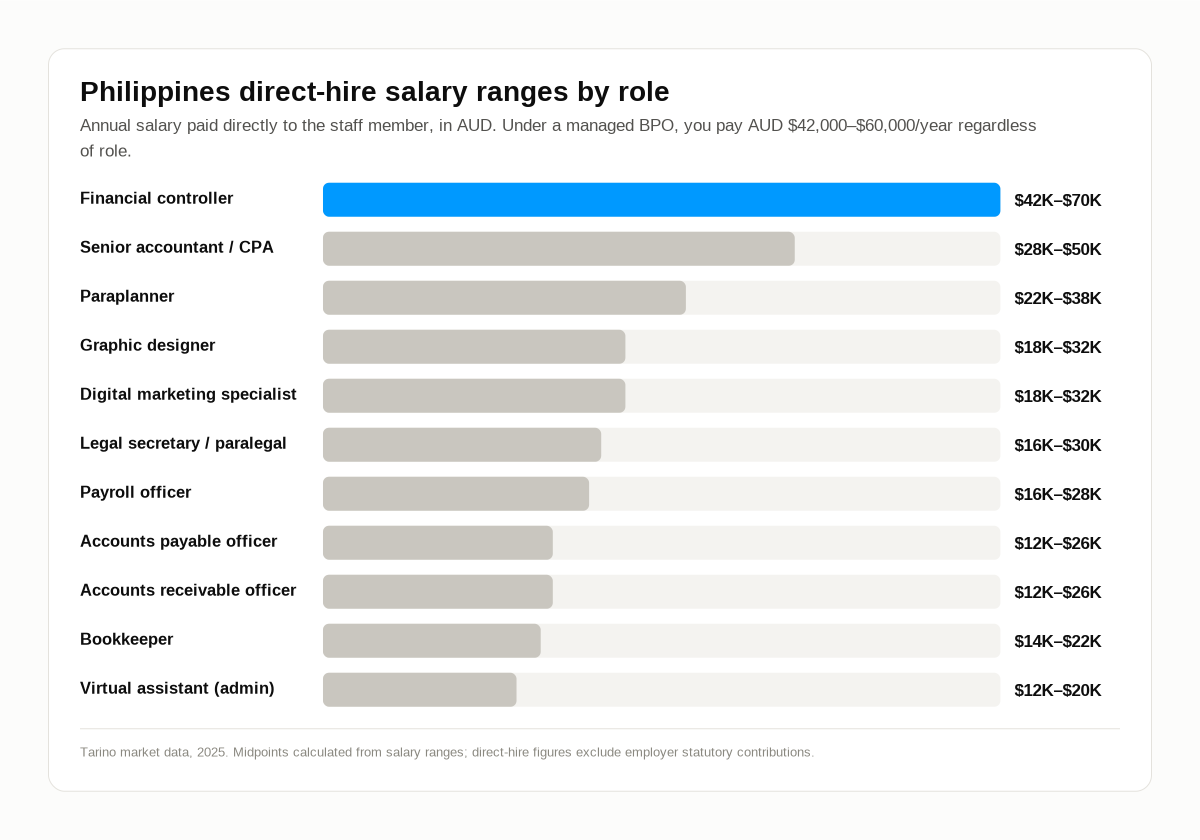
Outsourcing to the Philippines can save Australian businesses up to 75–80% on salaries compared to local equivalents. As a concrete example, hiring a customer support representative in the Philippines costs approximately USD $500–$1,000 per month (around AUD $9,000–$18,000 per year) under a direct-hire arrangement. The figures below are direct-hire salary ranges — the amount you pay the person directly. Under a managed BPO model, you would pay AUD $42,000–$60,000 per year per person regardless of their actual role-level salary, because the provider’s margin is built in. The table uses a managed seat rate of $3,500/month ($42,000/year) for the BPO cost column.
Role | AUD/year (direct hire) | 3-year direct hire cost (incl. $5K fee yr 1) | 3-year managed seat cost (at $3,500/mo) |
|---|---|---|---|
Bookkeeper | $14,000–$22,000 | $53,000–$71,000 | $126,000 |
Accounts payable officer | $12,000–$26,000 | $41,000–$83,000 | $126,000 |
Accounts receivable officer | $12,000–$26,000 | $41,000–$83,000 | $126,000 |
Senior accountant / CPA | $28,000–$50,000 | $89,000–$155,000 | $126,000 |
Financial controller | $42,000–$70,000 | $131,000–$215,000 | $126,000 |
Paraplanner | $22,000–$38,000 | $71,000–$119,000 | $126,000 |
Legal secretary / paralegal | $16,000–$30,000 | $53,000–$95,000 | $126,000 |
Virtual assistant (admin) | $12,000–$20,000 | $41,000–$65,000 | $126,000 |
Graphic designer | $18,000–$32,000 | $59,000–$101,000 | $126,000 |
Digital marketing specialist | $18,000–$32,000 | $59,000–$101,000 | $126,000 |
Payroll officer | $16,000–$28,000 | $53,000–$89,000 | $126,000 |
Note that for senior roles — financial controllers, senior CPAs — the managed BPO seat at $126,000 over three years is actually cheaper than the direct salary cost at the top of the range. The direct hire model is most advantageous for mid-tier roles where the salary sits well below $42,000/year.
Which roles outsource well for Australian professional services

Outsourcing to the Philippines is a strategy used by companies across multiple countries — the United States, United Kingdom, Australia, and Canada among the most prominent — because the combination of English fluency, Western cultural alignment, and graduate availability applies across all of them. For Australian firms specifically, the roles below represent the most established and reliable categories.
Accounting firms
Accounting is the most established category for Philippines outsourcing from Australia. The most commonly placed roles are offshore bookkeepers, accounts payable officers, accounts receivable officers, senior accountants (tax and BAS preparation), SMSF administrators, management accountants, and payroll officers. Cloud software like Xero and MYOB is fully accessible from the Philippines, and many candidates have years of experience running those platforms for Australian clients. For a broader view, see our guide to offshore staffing for accounting firms.
One compliance point worth noting: final BAS lodgement requires a TPB-registered Australian agent. All preparation work, reconciliations, workpapers, and draft returns can be completed offshore — the lodgement step stays onshore. Outsourced accounting services built on this model are now standard practice for mid-sized Australian accounting firms.
Legal firms
Legal secretaries, paralegals, legal researchers, conveyancing assistants, and litigation support officers are all well-suited to offshore placement. Philippines-based legal staff handle document preparation, matter management, legal research, and administrative tasks reliably. The constraint is the same as accounting: final advice and signing must come from the Australian-licensed solicitor. The preparation work — sometimes the bulk of a matter’s hours — can be done offshore at a fraction of the local cost.
Financial advisory and financial planning
Paraplanners, financial planning assistants, client services officers, and compliance administrators are the most common placements for financial advisory firms. Philippines-based paraplanners understand SOA preparation, Xplan workflows, and ASIC compliance requirements. Many have prior experience working for large Australian planning groups through BPO providers, which means the learning curve on Australian-specific processes is shorter than most firms expect.
Consulting firms
Research analysts, management consultants, data analysts, business analysts, and executive assistants all transfer well. Philippines-based analysts have worked at McKinsey Knowledge Center, BCG KNS, Accenture Research, and other global consulting support hubs in Manila — the talent pool for structured analytical work is genuine and deep. Australian consulting firms using offshore analysts typically find the quality comparable to graduate-level local hires at a significantly lower cost.
Digital marketing roles
Digital marketing is one of the most commonly outsourced role categories to the Philippines. Social media managers, SEO specialists, content writers, paid media coordinators, and digital marketing specialists are all well represented in the Philippine talent pool. Pay for a digital marketing specialist sits at AUD $18,000–$32,000 per year on a direct-hire basis, compared to AUD $65,000–$90,000 for an equivalent local hire.
Customer service
Customer service is among the most common outsourcing roles in the Philippines. The country’s BPO industry was built substantially on customer support work, and the combination of English fluency, Western cultural alignment, and time zone positioning makes Philippine-based customer service teams effective for Australian businesses. Time zone differences allow Philippine teams to provide 24/7 coverage for global clients when shifts are structured appropriately.
Virtual assistants (all industries)
VAs in the Philippines handle diary management, inbox management, travel booking, client onboarding admin, social media scheduling, and CRM data entry. Pay for a virtual assistant Philippines ranges from AUD $12,000–$20,000 per year depending on experience and specialisation. This is the most common entry-point role for Australian businesses new to Philippines outsourcing — the scope is defined, the handover is straightforward, and the savings are immediate.
Philippines outsourcing compliance basics for Australian businesses
Do you pay super for Philippines-based staff?
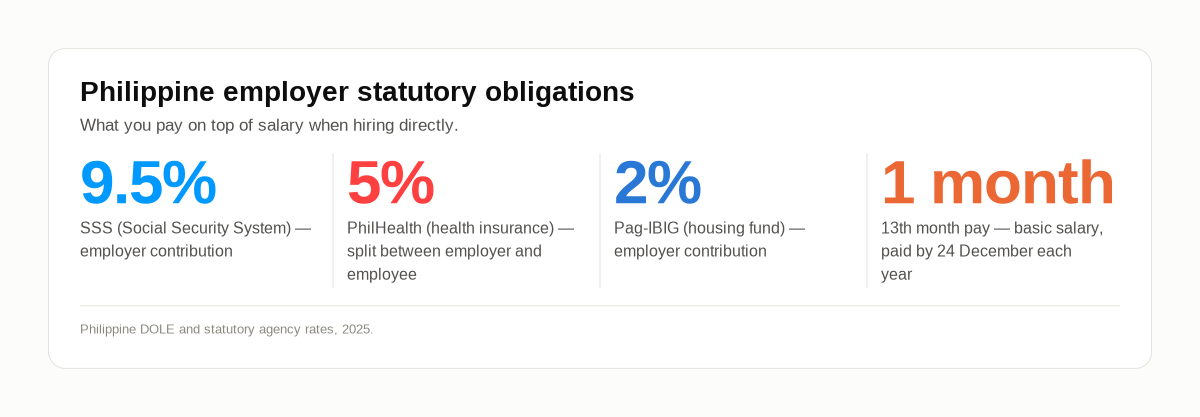
No. Superannuation is an Australian obligation that applies to Australian-resident employees. Philippines-based staff are hired under Philippine law and receive Philippine statutory benefits instead. As the employer, you are responsible for: SSS (Social Security System), with a 9.5% employer contribution; PhilHealth (health insurance), 5% split between employer and employee; Pag-IBIG (housing fund), 2% employer contribution; and 13th month pay, which is one month’s basic salary paid by December 24 each year — a mandatory benefit under Philippine law. Under an EOR arrangement, the EOR provider manages these on your behalf. Under direct hire, you manage them directly.
Do Philippines-based staff need an Australian work visa?
No. They work from the Philippines and have no need for an Australian visa. If a staff member ever visits Australia for work purposes — a team offsite or onboarding trip, for example — they would apply for a standard visitor visa for that trip only. Day-to-day, there is no visa requirement of any kind.
What about the DOLE contractor trap?
Philippine labor law recognises a legal risk called sham contracting: where someone works exclusively for one company under conditions that look like employment (fixed hours, single client, supervised work) but is paid as a freelancer or contractor. Philippine labor laws are strict, and employee termination requires detailed documentation — which is why having correct employment terms in place from the start matters. Australian businesses hiring Philippines-based workers on a regular, full-time basis should ensure the worker is genuinely hired with proper employment terms — not falsely labelled a contractor. Direct hire with correct employment documentation is the cleaner solution. An EOR can also manage this correctly on your behalf if you prefer not to run Philippine employment paperwork directly.
What are the significant challenges in outsourcing to the Philippines?
The two most commonly cited challenges in outsourcing to the Philippines are high attrition rates and communication issues. Attrition is higher in the BPO sector than in direct-hire arrangements, because managed seat workers have less loyalty to the client business than to the provider. Direct hire reduces attrition risk significantly. Communication issues most often arise from unclear processes and inadequate onboarding rather than language barriers — English is an official language in the Philippines, used in education and business communication, so fluency is rarely the problem. Structured handovers, documented workflows, and regular check-ins address the majority of communication challenges.
How to get started with Philippines outsourcing

- Decide what role to outsource first. Start with one clearly defined role, not five at once. The clearer the scope, the faster the placement and the smoother the onboarding, and it helps you assess whether the role fits your business needs.
- Write a job brief. Specify the tasks, software tools, hours, and experience level required. A one-page brief is enough — but it needs to be specific. “Bookkeeper with Xero experience, 38 hours per week, AEST hours, preparing bank reconciliations and BAS workpapers” is a usable brief. “Someone to help with accounts” is not. Define working hours clearly as well, especially if you need after-hours or follow-the-sun coverage, since time zone differences allow Philippine teams to provide 24/7 support for global clients when shifts are structured correctly.
- Choose your model. Managed BPO is fastest but carries indefinite ongoing fees. EOR gives you direct control with HR support. Direct hire is the cheapest long-term option and gives you full ownership of the relationship. Your outsourcing strategy should reflect your budget, goals, and how much control you want day to day.
- Screen candidates. For direct hire, use a recruitment firm like Tarino to find, test, and shortlist Philippines-based candidates. Tarino conducts skills assessments and reference checks before presenting a shortlist.
- Onboard properly. Spend two to four weeks on systems access, process documentation, and daily check-ins before expecting independent output. Philippines-based staff are capable of working autonomously — but like any new hire, they need a structured handover with clear expectations to get there. Significant challenges in outsourcing to the Philippines include high attrition rates and potential communication issues; structured onboarding and documented processes reduce both.
The average time from starting a Tarino search to hire is 4–6 weeks.
The Tarino teamTarino publishes what it learns from the work itself.
This page is general information, not legal, tax or financial advice. Check your situation with a qualified adviser.