



On this page6 sections
- Hire Offshore Finance Manager Australia: What This Page Covers
- What a finance manager does (and how it differs from other finance roles)
- What a Philippines-based finance manager costs to hire directly
- Where Philippines-based finance managers come from
- What to test for in the hiring process
- What Australian firms use an offshore finance team for
Written byTarino Editorial Team**· Offshore Staffing Specialists · Published 19 November 2026
Hire Offshore Finance Manager Australia: What This Page Covers
This guide explains how to hire offshore finance manager Australia-style: directly, without an ongoing agency arrangement, using a Philippines-based professional. It covers what the role actually involves, what it costs, where the candidates come from, and what to test before you make an offer, and is provided as general information only, not legal, tax, or financial advice tailored to your circumstances. It is written for principals of Australian accounting practices and professional services Australian businesses who need someone to own their financial reporting and budgeting cycle every month, not a CFO, and not a tax accountant.
In this guide
- What this page covers
- What a finance manager does (and how it differs from other finance roles)
- What a Philippines-based finance manager costs to hire directly
- Where Philippines-based finance managers come from
- What to test for in the hiring process
- What Australian firms use offshore finance managers for
- Frequently asked questions
Start with the cost gap. Australian finance managers earn $100,000–$160,000 per year base, plus 11% super, while local finance staff in Australia commonly cost $65,000–$90,000 AUD at lower levels. A Philippines-based finance manager hired directly costs $35,000–$55,000 per year, with a one-off placement fee instead of an ongoing monthly markup. Offshore hiring often reduces finance staff costs by 60%–70%, with net savings typically landing at 40%–60% after direct-hire costs and setup. That difference compounds quickly. The three-year comparison below makes it concrete.
What a finance manager does (and how it differs from other finance roles)

A finance manager owns the finance function day to day for a business or business unit. More senior than a senior accountant doing client work, less strategic than a CFO setting capital structure. The practical remit looks like this, and in offshore structures a common setup is one onshore senior for every two to four offshore juniors:
- Monthly management accounts preparation, P&L, balance sheet, and cash flow statement
- Budget preparation and variance analysis across the business
- Financial reporting to principals, partners, or a board
- Rolling 13-week cash flow forecasting
- Accounts payable and receivable oversight (managing the team, not processing transactions)
- Payroll review and sign-off
- Financial policy and procedure maintenance
- Liaison with external auditors and tax agents
- Management of a small finance team, often a small team of accountants
Three adjacent roles appear on separate Tarino pages, and they are genuinely different:
- Hire a Philippines-based financial controller for C-suite financial leadership. The financial controller sits above the finance manager: they own treasury, group consolidations, audit liaison at board level, and C-suite reporting. For firms under $20M revenue, the finance manager often covers some of this ground, but the roles are distinct.
- Management accountant (see the offshore management accountant roles in Australia guide): focused on cost centre analysis, product costing, and variance reporting for operational decisions. That is a specialist function, not the generalist oversight role of a finance manager.
- Financial analyst: focused on financial modelling, valuations, and scenario analysis. Not operational financial management.
- Senior accountant: focused on client-facing compliance work in a practice context. Not internal financial management.
If your firm needs someone to take ownership with minimal handover, this is the person responsible for running the finance function, leading the onshore team where required, and keeping the budget on track. The titles above do something meaningfully different.
What a Philippines-based finance manager costs to hire directly
Philippines finance manager salaries paid by Australian firms hiring directly break into three tiers based on experience:
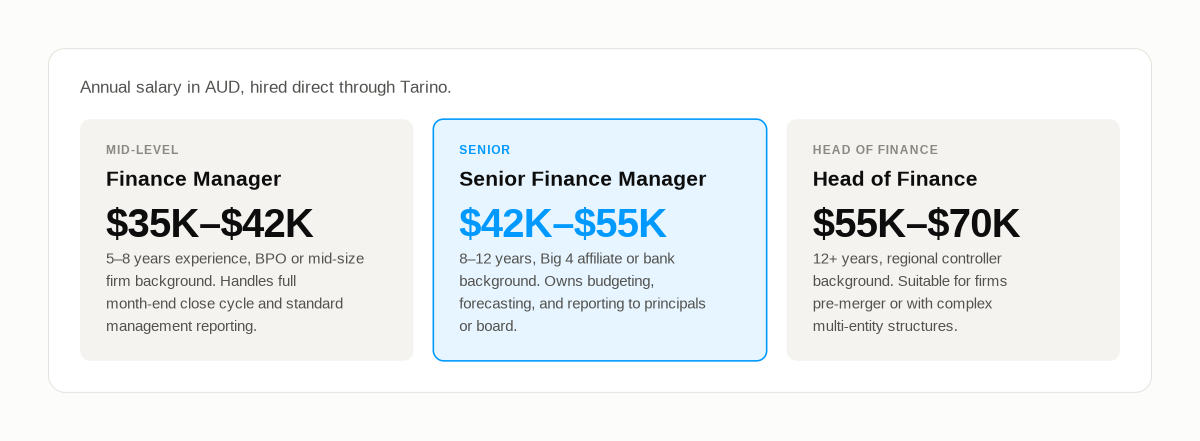
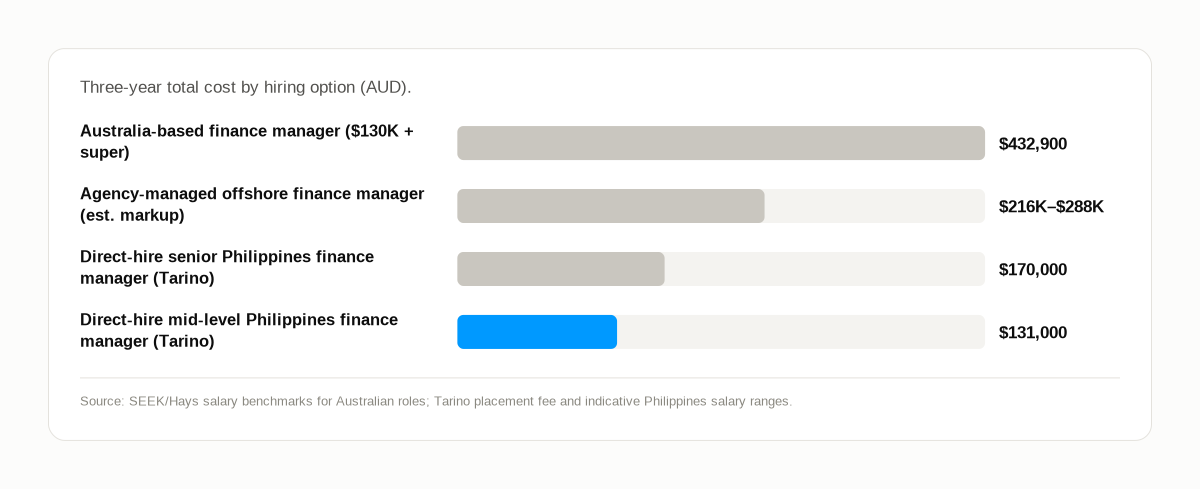
Compare that to the Australian market. SEEK and Hays benchmark Australian finance managers at $100,000–$160,000 per year base, plus 11% superannuation. Interim finance managers in Australia often charge A$700 to A$1,200 per day, which is why many businesses use them only as a temporary bridge. At a mid-point of $130,000 base, the all-in annual cost is $144,300. Over three years, the numbers look like this:
- Australia-based finance manager at $130K plus 11% super: $144,300 per year, $432,900 over three years
- Agency-managed offshore finance manager, estimated $6,000–$8,000 per month markup model: $72,000–$96,000 per year, $216,000–$288,000 over three years
- Direct-hire Philippines finance manager through Tarino ($5K placement fee plus $42K salary): $47,000 in year one, $42,000 in years two and three, $131,000 total
- Direct-hire senior Philippines finance manager through Tarino ($5K placement fee plus $55K salary): $60,000 in year one, $55,000 in years two and three, $170,000 total
That means offshore finance roles commonly save 60% to 70% on labour costs, with realised savings often landing around 40% to 60% depending on salary level and setup.
Tarino’s fee structure is $250 upfront plus $4,750 on hire (excl. GST), one fee, no ongoing monthly markup. You hire the offshore finance staff member directly and pay their salary, which also lets you scale support as needed without taking on high overheads. Tarino also provides 6-month replacement cover. To understand how agency markups accumulate compared to this model, see what agencies charge on top of staff salaries in Australia.
Where Philippines-based finance managers come from

The Philippines is one of the main talent pools Australian businesses use for offshore finance hiring, alongside India. For Australian firms, three feeder environments are worth knowing.
Big 4 Philippine affiliates. SGV & Co (EY’s Philippines affiliate), Isla Lipana & Co (PwC’s Philippines affiliate), P&A Grant Thornton Philippines, and R.G. Manabat & Co. (KPMG Philippines) all train finance professionals to international standards. Candidates from these firms understand audit-ready financial reporting, multi-entity structures, and the documentation rigour Australian principals expect.
Large Philippine corporates. Finance managers from Ayala Corporation, SM Group, Metrobank, BDO Unibank, and San Miguel Corporation have owned full-cycle management reporting, budgets, monthly accounts, cash flow forecasting, for organisations far larger than most Australian professional services firms. This is not junior preparation work; it is the actual job.
Australian-focused BPOs. Many Philippines finance professionals have already spent three to five years supporting Australian accounting practices in BPO environments. They know accounting systems like Xero and MYOB, Australian compliance context, BAS workpapers, PAYG reconciliations, payroll sign-off, and the routine processing work that sits inside those accounting systems. The learning curve for an Australian firm is shorter than most principals expect.
The Philippines CPA designation is issued by the Professional Regulation Commission (PRC) and requires passing a national licensure examination that is competitive and rigorous. Offshore finance managers typically hold CPA or CA qualifications, and the Philippines is one of the highest-volume exam-sitting countries in Asia. Senior offshore finance roles generally require several years of post-qualification experience.
Tools and systems you can expect candidates to know: Xero, MYOB, QuickBooks, SAP, NetSuite, Microsoft Dynamics, Power BI for dashboards, and Advanced Excel. Pivot tables, SUMIF, VLOOKUP, and Power Query are standard, not aspirational.
What to test for in the hiring process

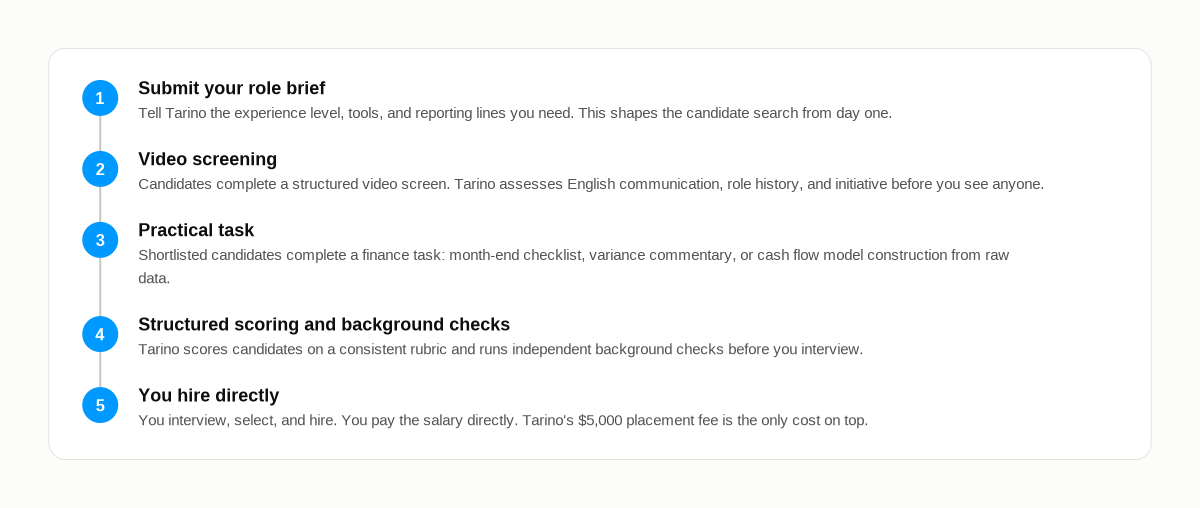
Tarino uses video screens, practical tasks, and structured scorecards. For a finance manager role, the practical task should cover four areas:
- Month-end close checklist completion. Give candidates a partial close checklist and raw trial balance. Speed and accuracy both matter, a finance manager who takes two weeks to close is a problem regardless of quality.
- Variance commentary quality. Can they explain a P&L movement in plain English? Give them a month-on-month P&L with three material variances and ask for a written management commentary across the reporting cycle. This is the core communication skill principals rely on.
- Cash flow model construction. Provide raw accounts payable and receivable data and ask for a 13-week cash flow model. The structure they build tells you more than any CV line.
- Chart of accounts review. Can they spot miscodings across the chart of accounts and accounting system? Give them a trial balance with three deliberate coding errors. A good finance manager catches this without being prompted.
Quality assurance depends on clear documentation and review layers, especially where high volume work cannot be checked line by line.
On the video screen, assess three things: English communication clarity (Australian principals need to be able to present management accounts together without friction), how the candidate structures and explains their previous role, and whether they can point to processes or reporting improvements they initiated. Offshore staff generally need more oversight than local hires, especially early on. Initiative is harder to test than technical skill, but offshore finance staff typically require more management oversight, so you also need people with strong process discipline who can manage repeatable work well over time.
What Australian firms use an offshore finance team for

Accounting practice (partnership model). A managing partner spending eight hours a month on internal P&L and WIP reporting reclaims those hours for billable work. The finance manager may also manage a small finance team or offshore finance team while running the monthly close, preparing the partner distribution report, monitoring WIP and lock-up, and reporting debtor aging. The partner reviews the output and signs off. That is the entire handover.
Financial advisory firm (AFS licensee). A firm with 10–20 advisers needs revenue reporting by adviser and by product, fee revenue tracked against budget, a monthly P&L for the principal, and coordination with external accountants for FY close and audit. All of that sits inside the finance manager’s remit, and time-zone differences can extend working hours for finance operations in Australian businesses around close and reporting deadlines. Banking access, approvals, and other controls should stay with the local lead even when delivery is offshore. For more on offshore staffing for Australian financial planning firms, that guide covers the broader staffing picture.
Management consulting firm. Project-based revenue means cash flow is lumpy. A finance manager runs rolling cash flow forecasts, tracks project profitability by engagement, prepares client billing schedules, and flags overruns to partners before they become write-offs. Where output is going to clients, or approvals and reviews are involved, offshore staff still need more oversight than local hires and local review when needed. These are functions that otherwise fall through the gap between the operations team and the external accountant.
Growing accounting practice (pre-merger). A practice considering acquiring a competitor needs vendor due diligence support data, a modelled combined-entity P&L, and integration cost tracking. Work that would otherwise land on the managing partner’s desk sits squarely within what a finance manager at head-of-finance level handles. The $55,000–$70,000 salary tier exists precisely for this kind of expanded scope.
The Tarino teamTarino publishes what it learns from the work itself.
This page is general information, not legal, tax or financial advice. Check your situation with a qualified adviser.