



On this page8 sections
- Accounts Receivable Outsourcing Services in Australia: Provider Fees vs Hiring Your Own Offshore AR Officer
- What accounts receivable outsourcing actually means
- What managed accounts receivable outsourcing services charge
- What it costs to hire your own offshore AR officer in the Philippines
- Three-year cost comparison
- What an offshore AR officer does day-to-day
- When a managed service might still make sense
- Data privacy and compliance when hiring offshore AR staff
Written byTarino Editorial Team**· Offshore Staffing Specialists · Published 10 November 2026
Accounts Receivable Outsourcing Services in Australia: Provider Fees vs Hiring Your Own Offshore AR Officer
Australian professional services firms, accounting practices, law firms, consulting businesses, are sitting on debtor ledgers that keep growing. Getting invoices paid takes consistent, disciplined follow-up. The principal rarely has time for it. The practice manager is already stretched. So the aged AR blows out, cash flow suffers, and chasing clients for money becomes a part-time job nobody signed up for.
In this guide
- What accounts receivable outsourcing actually means
- What managed accounts receivable outsourcing services charge
- What it costs to hire your own offshore AR officer in the Philippines
- Three-year cost comparison
- What an offshore AR officer does day-to-day
- When a managed service might still make sense
- Data privacy and compliance when hiring offshore AR staff
- Frequently asked questions
Two real options exist. The first is a managed accounts receivable outsourcing service, where a third-party provider handles your collections using their own staff and systems. The second is hiring a dedicated Philippines-based AR officer who works inside your ledger, knows your clients, and operates entirely under your direction. This page compares accounts receivable outsourcing services with direct-hire offshore AR staff so you can weigh the costs and control trade-offs side by side.
What accounts receivable outsourcing actually means
When most search results talk about accounts receivable outsourcing, they mean a managed service. You hand over your debtor list to a provider, their team sends the chasers, and you pay per invoice or per dollar recovered. The first is a managed accounts receivable outsourcing service: an outsourced accounts receivable model where the provider handles routine receivables management through their own workflows, scripts, and staff, which can reduce admin and free your internal team to focus on core business operations. You get a service. You do not get a person.
Hiring a dedicated offshore AR officer is a different model entirely. That person works for your firm, inside your Xero or MYOB file, using your firm’s voice and your knowledge of the client relationship. They attend your team meetings. They know that Client A is a slow payer who responds to phone calls, and that Client B disputes invoices when the work hasn’t been explained clearly. That context is worth money, and a managed outsourcing service cannot carry it.
What managed accounts receivable outsourcing services charge

Managed AR providers in Australia price their services a few different ways. Per-invoice fees typically run AUD $5–$15 per invoice chased, depending on the aging bracket and how complex the follow-up needs to be. Contingency collection agencies usually take 10–25% of the amount they recover. Some providers offer a monthly seat model, running AUD $3,500–$9,000 per month for a dedicated AR function.
A mid-size professional services firm with $500,000–$2 million in annual billings and 60-day debtors would typically land in the $4,000–$6,000 per month range under a managed model for accounts receivable outsourcing services. Compared with in-house AR management, that can be more predictable because internal teams usually require higher investments in staffing and software. Many accounts receivable services also bundle workflow tools into their pricing, giving clients cost effective solutions and support for core financial processes without significant capital investment. Add setup fees of $1,000–$3,000, minimum contract terms of around 12 months, and the reality that whoever is working your account is juggling other clients at the same time. Lower overhead costs can be part of the appeal, but your debtors are not their sole focus.
What it costs to hire your own offshore AR officer in the Philippines
When you go direct-hire for offshore accounts receivable, you pay two things: the AR officer’s salary, and a one-off placement fee. No monthly markup sitting on top forever.
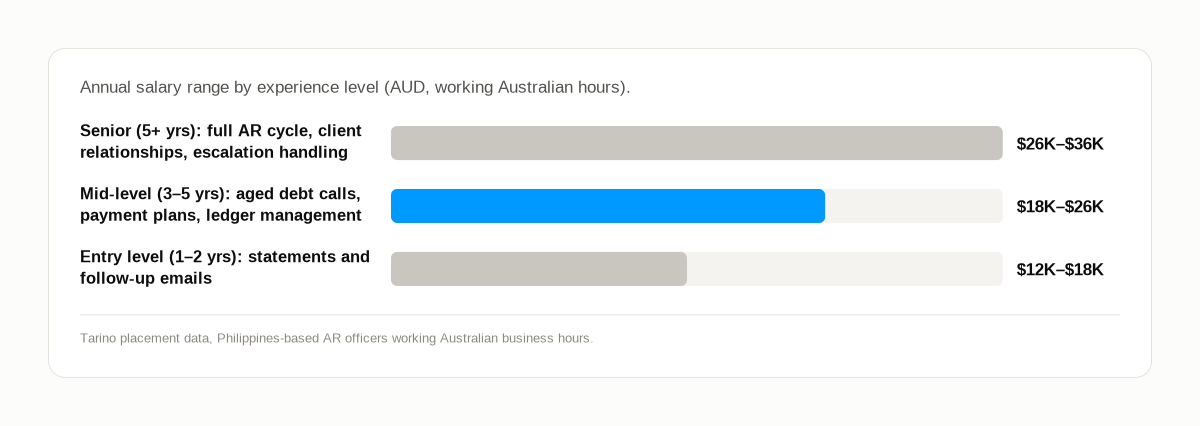
Salary ranges for Philippines-based AR officers working Australian business hours break down as follows. At entry level, with one to two years of experience, an officer handling statement sending and follow-up emails costs AUD $12,000–$18,000 per year. A mid-level officer with three to five years of experience, capable of aged debt phone calls, payment plan negotiation, and full debtor ledger management, costs AUD $18,000–$26,000 per year. A senior AR officer with five or more years, who can own the full AR cycle, manage client relationships, handle escalations, and liaise with your legal team on disputes, costs AUD $26,000–$36,000 per year.
Some firms turn to outsourced accounts receivable management to reduce administrative workload, with providers claiming operational reductions of up to 99%. When managing accounts receivable this way, compare more than price alone, as some providers also advertise process success rates of up to 99%.
The Tarino placement fee is one-off: $250 upfront plus $4,750 on hire, excl. GST. Once your AR officer is hired, there is no ongoing monthly markup. Candidates are screened in the Philippines and hired directly by you, the client. The placement fee is paid once only and does not recur. You pay the AR officer’s salary directly via Wise, Payoneer, or direct bank transfer. Tarino includes a six-month replacement guarantee.
For more on how direct offshore hiring works without agency fees, see our guide to hiring an offshore AR officer in Australia without agency fees.
Three-year cost comparison
The table below models three scenarios: a managed AR outsourcing service at $5,000 per month, a dedicated offshore AR officer hired at a mid-level salary of $22,000 per year, and AR handled in-house using practice manager time at an equivalent annual cost of $40,000.
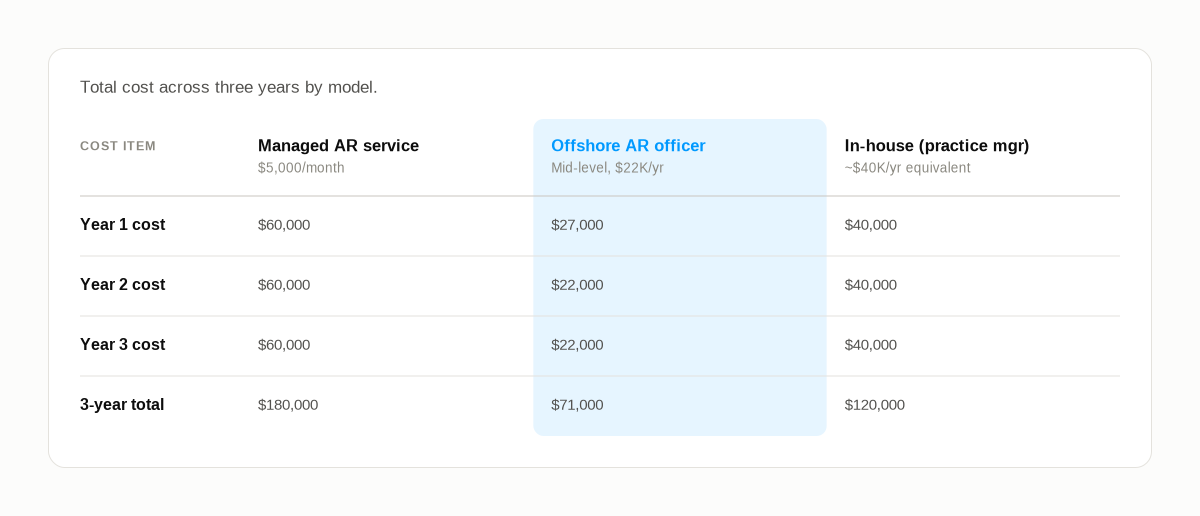
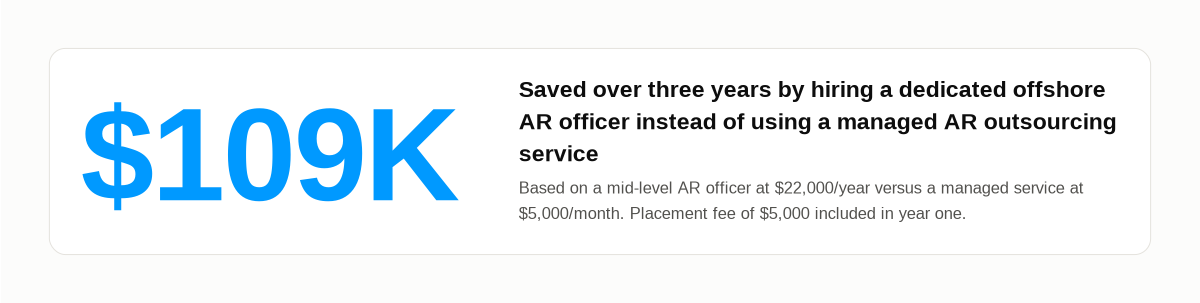
Over three years, a direct-hire AR officer saves approximately $109,000 compared to a managed outsourcing service. Businesses usually compare models on KPIs such as Days Sales Outstanding and collection effectiveness, not just headline cost, because those measures shape receivables performance, financial visibility, and cash flow management. The practice principal also keeps full control over how collections are handled, which matters in professional services where client relationships are central to everything. A third-party collections script does not know that your best client is going through a rough quarter and needs a softer approach this month, while consistent follow-up can reduce DSO when receivables are handled properly.
What an offshore AR officer does day-to-day

An offshore AR officer hired through this model is a full working team member, not a ticketing system. Their daily work typically covers:
- invoice generation and sending statements immediately upon completion of work to support timely invoicing
- Following up overdue invoices at 7, 14, 30, 60, and 90 days via email, phone, and automated reminders or scheduled follow-up sequences that help avoid delays in customer payments
- Maintaining the debtor ledger in your accounting software, whether that’s Xero, MYOB, or QuickBooks, with accurate payment tracking
- Recording every debtor contact and outcome in your practice management system (Karbon, MYOB AO, GreatSoft)
- Negotiating payment plans with clients who are overdue but still engaging
- Flagging disputed invoices for principal review before any escalation
- Preparing weekly aged debtor reports and supporting account reconciliation so you can see the ledger position without digging through it yourself
- Coordinating with your accountants or admin team when a debtor requires a formal demand or handover to a solicitor
That is the full AR cycle, handled consistently, without pulling the principal into routine follow-up, which helps ensure timely payments and improve cash flow. The person doing it knows your firm, your clients, and your preferred tone, none of which a managed service delivers.
If your practice also needs help managing what goes out, see outsourcing accounts payable through a dedicated offshore AP officer for a similar breakdown on that side of the ledger.
When a managed service might still make sense

Managed AR outsourcing is not always the wrong call. Fewer than 20 invoices per month, and a per-invoice model might work out cheaper than carrying a full-time hire. You should also assess whether the provider can handle changing transaction volumes over time. Scalability matters if seasonal demand or business growth is likely to change your invoice volumes. If you need debt collection on a one-off basis for a specific aged debt portfolio, a contingency collection agency is probably the right tool. And if your AR problem is a temporary blowout rather than a structural issue, a short-term managed service might be enough to clear the backlog. Compare managed providers against your business needs, especially when invoice volumes increase. Also look for a proven process success rate.
But if your firm is billing consistently, your debtor ledger is a permanent fixture, and you’re spending real time managing follow-up each month, the economics of a dedicated offshore AR officer are hard to argue with. The savings in year one alone cover the cost of a junior-to-mid hire, and from year two the gap widens considerably.
For a broader look at how offshore hiring compares to domestic staffing costs in professional services, the true cost of hiring an accountant in Australia is a useful reference point for the same type of calculation.
Data privacy and compliance when hiring offshore AR staff

Putting a Philippines-based officer inside your debtor ledger raises a legitimate question about data privacy. Your debtor ledger contains client names, invoice details, and payment history. Under the Australian Privacy Act, you are responsible for how that data is handled regardless of where the person handling it is located.
In practice, this is managed the same way you’d manage it with any staff member: role-based access in your accounting software, a signed confidentiality agreement, and clear protocols for handling client data. Outsourcing arrangements should also support compliance with financial regulations. Tarino provides guidance on this as part of the placement process, helping centralise financial data across your accounting software and other financial systems while preserving financial control over approvals and exceptions. For a full compliance checklist, evaluate industry experience and data security standards when comparing any offshore or managed provider. The Australian data privacy compliance checklist for businesses hiring offshore covers the specific obligations.
The Tarino teamTarino publishes what it learns from the work itself.
This page is general information, not legal, tax or financial advice. Check your situation with a qualified adviser.