



On this page6 sections
- Accounting Practice Management Software: What Australian Firms Use and What It Costs (2026 Guide)
- What accounting practice management software actually does
- The main accounting practice management software platforms in Australia
- Which platform suits which firm size
- What accounting practice management costs in total
- Accounting practice management: software is only part of the equation
Written byTarino Editorial Team**· Offshore Staffing Specialists · Published 16 November 2026
Accounting Practice Management Software: What Australian Firms Use and What It Costs (2026 Guide)
Accounting practice management software covers the tools firms use to run their operations: client and contact databases, job and workflow tracking, timesheets, billing, work-in-progress (WIP), document storage, and staff assignments. The best-known options in Australia are MYOB AO (Accountants Office), HandiSoft (now Sage HandiSoft), Karbon, Xero Practice Manager, and GreatSoft. Each has a distinct set of strengths, and the right choice depends heavily on your firm’s size, existing software ecosystem, and workflow complexity.
In this guide
- What accounting practice management software actually does
- The main accounting practice management software platforms in Australia
- Which platform suits which firm size
- What accounting practice management costs in total
- Accounting practice management: software is only part of the equation
- Frequently asked questions
This guide compares the main platforms, their core functions, and pricing, and flags the implementation realities that vendor websites tend to gloss over.
What accounting practice management software actually does
At its core, a practice management system does six things: supports client management with a CRM-style database of all your clients and related entities; handles workflow management, task tracking, and job management across work in progress; records time and WIP (timesheet entries, billing rates, write-offs, and billings against budget); manages invoicing and debtor follow-up; stores and organises documents; and handles staff assignments. It also creates repeatable compliance workflows, with automated reminders and compliance calendars to reduce missed deadlines. Some platforms go further. GreatSoft includes ATO lodgement status tracking and ASIC compliance tools, while MYOB AO integrates directly with MYOB Tax. It helps with job tracking by tracking jobs through stages, assigning work, monitoring deadlines, checking job status, and following outstanding tasks. Time and WIP features also support time tracking and practice time, and built-in timers help capture every billable hour accurately. Document features centralise client information and client data, while document management supports secure file sharing and electronic signatures, and centralised client data gives teams a consistent view. What practice management software does not do is replace your accounting or tax preparation tool. Xero, MYOB, or QuickBooks handles the client ledger, and Xero integrates with over 1000 certified apps; your practice management platform sits alongside them as one connected system that links practice workflows with the wider tech stack.
The main accounting practice management software platforms in Australia

Platform | Cloud / Desktop | Best for | Approximate annual cost (per user) | Key integrations |
|---|---|---|---|---|
MYOB AO | Desktop (cloud features being added) | Mid-to-large firms on the MYOB ecosystem; complex multi-partner billing | AUD $1,500–$5,000+ (varies by modules) | MYOB Tax, ATO portal, MYOB Payroll |
HandiSoft (Sage) | Desktop with some cloud modules | Smaller firms managing trusts, SMSF, and general accounting | AUD $1,000–$3,000 | Sage Handiledger, BGL, Class Super |
Karbon | Cloud-native | Mid-size firms wanting work, communication, and client deliverables in one place; strong for Xero practices | AUD $720–$1,200 (Teams plan) | Xero, Gmail, Outlook, Microsoft 365, QBO |
Xero Practice Manager | Cloud-based | Xero-centric firms wanting a cloud platform, best combined with Xero HQ for client portal | Bundled in Xero Partner program tiers | Xero, Xero Tax, Xero Workpapers, Xero Payroll |
GreatSoft | Cloud-native | Firms with significant corporate secretarial, ATO lodgement tracking, and ASIC compliance work | AUD $960–$1,800 | ASIC, ATO portal, Xero, MYOB |
Note: MYOB Practice Management is the cloud-based MYOB option, and it connects with third-party solutions like Power BI. Most platforms have changed their pricing structures in the past 12–18 months. The figures above are market estimates for illustration, verify current pricing directly with each vendor before signing anything.
Which platform suits which firm size

Sole practitioner and boutique (1–5 staff)
For small Xero-centric practices, Xero Practice Manager is the most cost-effective starting point, and Xero partners get Xero Partner Hub free when they join the partner program. It’s bundled into the Xero Partner program, so there’s no additional per-seat charge at the lower tiers, and Xero Partner Hub integrates natively with Xero accounting software. Karbon is worth evaluating even at small scale if your workflow complexity justifies it; for small firms, recurring compliance deadlines can quickly make straightforward job visibility and tracking jobs with automated templates a priority, especially with multiple service lines or a heavy client communication load. HandiSoft suits practices carrying legacy systems or doing meaningful trust and SMSF work. MYOB AO makes sense if the firm is already deeply inside the MYOB ecosystem and switching costs would outweigh the gains.
Mid-size (5–20 staff)
At this size, cloud-native workflow visibility becomes genuinely valuable, and for mid-size firms so do capacity planning and reporting depth. You need to see who is working on what, where jobs are stalled, and what’s sitting in a queue, with clear job visibility and enough control to act on issues early; real-time dashboards also show team utilization and project profitability. Karbon and GreatSoft are both worth evaluating here. XPM scales well for Xero-dominant practices, and MYOB AO remains common in established mid-size firms that have been on it for years, while stronger reporting also helps monitor productivity and recoverable costs, including the performance reports Xero offers. The key question at this scale is how much of your work involves ASIC compliance and corporate secretarial. If the answer is “a lot,” GreatSoft’s native ASIC integration gives it a material edge over the alternatives. Live client metrics and standardised reporting templates also support better advisory work across a growing client base.
Large (20+ staff)
MYOB AO, GreatSoft, and Karbon are the typical choices for larger practices. Integrations with payroll, trust accounting, and document management become critical at this scale, not nice-to-have. Access controls, data security, and audit trails matter more too, and practice management software should meet relevant security certifications given that financial services has the third-highest cyber attack rate. Cloud-native platforms have an advantage in multi-office or distributed team environments, which is increasingly relevant for how a larger firm operates across multiple locations or time zones, while automated workflows help bigger teams maintain consistent service quality across clients as the firm grows.
What accounting practice management costs in total

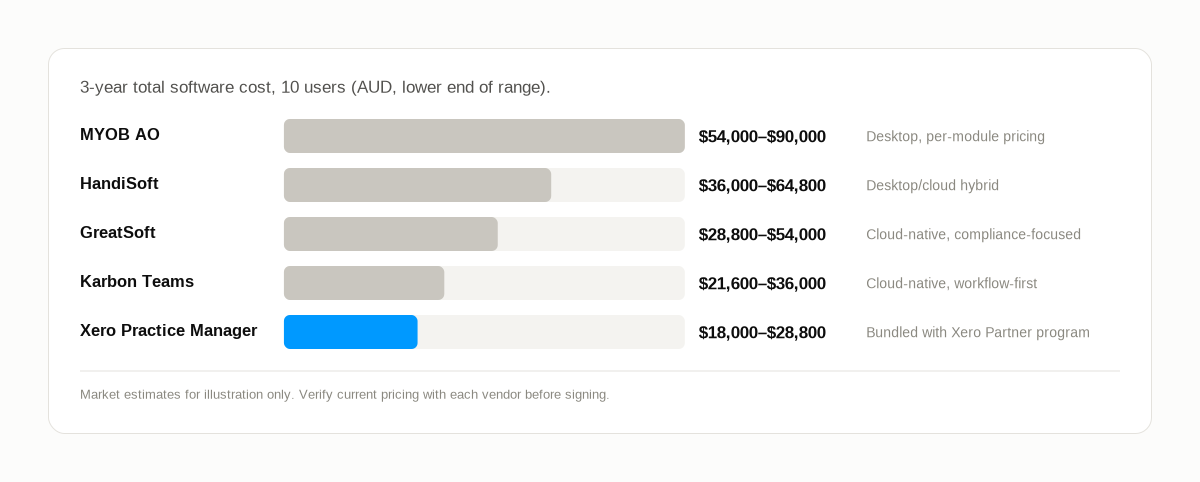
The per-user monthly figure rarely tells the full story, so build a business case around three-year costs, including add-ons and training. Below is a realistic total cost of ownership for a 10-user firm over three years, based on the pricing ranges above.
Platform | Per user/month (approx.) | 10 users, year 1 | 3-year total (10 users) |
|---|---|---|---|
MYOB AO | $150–$250 | $18,000–$30,000 | $54,000–$90,000 |
HandiSoft | $100–$180 | $12,000–$21,600 | $36,000–$64,800 |
Karbon (Teams) | $60–$100 | $7,200–$12,000 | $21,600–$36,000 |
Xero Practice Manager | Bundled / $50–$80 | $6,000–$9,600 | $18,000–$28,800 |
GreatSoft | $80–$150 | $9,600–$18,000 | $28,800–$54,000 |
These are software licence costs only. Lower per-user prices may not stay cheaper once multiple add-ons are required. Implementation, data migration, and the staff time involved in learning a new system are all on top. A full implementation at a mid-size firm, covering data migration from MYOB AO or HandiSoft, workflow redesign, and training, typically takes 3–6 months, and whether a full practice management suite or a narrower tool is better depends on the problem you are solving and choosing the right practice management software for that need. Cloud platforms generally move faster than desktop systems, which often require IT configuration and sometimes server infrastructure changes before anyone can log in.
Accounting practice management: software is only part of the equation
Practice management software automates workflow routing, timesheet tracking, and invoicing, reducing repetitive tasks so teams can focus on higher-value work. Someone still has to do the underlying work. In most accounting firms, that work falls to accountants who are overqualified for it, processing invoices, chasing aged debtors, entering timesheets, preparing ATO correspondence, running month-end procedures. Good practice management software makes this work faster. Xero users report saving an average of 6 hours on financial admin monthly, and 88% of Xero customers agree it frees up time for client focus. It doesn’t eliminate the need for people to do it.
Australian accounting firms increasingly look at offshore staffing for Australian accounting firms as a way to run work inside their cloud-based practice management systems. Karbon, XPM, GreatSoft, all fully accessible from the Philippines via a standard browser. A Philippines-based accountant or practice administrator can be productive in your Karbon or XPM workflow within weeks of onboarding, which also helps bookkeeping practices and firms with complex client portfolios support growth without adding local overhead. Many firms already use Philippines-based staff for client billing, WIP reconciliations, ATO correspondence, debtor follow-up, and practice administration, the kind of work that clogs a senior accountant’s week but doesn’t require a local hire. If you want to hire an offshore bookkeeper or practice administrator to work inside your systems, that’s a parallel decision to your software choice, not a replacement for it.
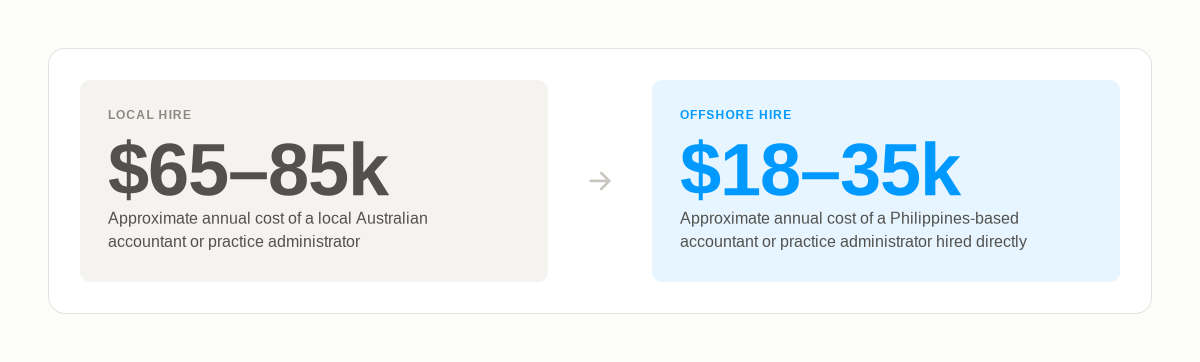
The cost arithmetic is straightforward. A mid-level Philippines-based accountant or practice administrator costs AUD $18,000–$35,000 per year when hired directly. The local equivalent runs AUD $65,000–$85,000 per year. That difference funds the software, the implementation, and meaningful capacity growth. For firms that want to hire an offshore accountant in Australia directly, no ongoing agency fees, that’s the model Tarino is built around: one flat fee, you hire and pay them directly. For firms that want to outsource accounting work without ongoing agency fees, direct hire is usually more cost-effective than a managed outsourcing arrangement over a 2–3 year horizon.
The Tarino teamTarino publishes what it learns from the work itself.
This page is general information, not legal, tax or financial advice. Check your situation with a qualified adviser.